
Winter Eczema on Hands: Dryness, Contact Dermatitis or Atopic?
Winter eczema on hands can be dryness, irritant or allergic contact dermatitis, or atopic hand eczema. What helps at home, and when to see a dermatologist.
On this page
By midwinter a lot of hands look alike at first glance: rough knuckles, tight fingertips, a crack beside a nail that stings at the sink. Some of that is dry skin, which settles with moisturizer. Some of it is hand eczema, and hand eczema has more than one cause. Which one you have decides what will help.
Winter eczema on hands is usually one of four things: plain dryness, irritant contact dermatitis from water and detergent, allergic contact dermatitis from something your hands touch, or atopic hand eczema in people who have had atopic dermatitis. Irritant contact dermatitis is the most common. Dermatology guidelines point to the same habits at home: gloves for wet chores, cotton gloves under them for longer jobs, gentle washing and a thick, fragrance-free moisturizer after every wash. See a dermatologist if moisturizing through the day has not helped within about two weeks, and sooner for deep cracks, blisters, pus or a rash that spreads beyond the hands.
Hand eczema is common. Quaade et al. (2021, Contact Dermatitis, PMID: 33548072) pooled 66 studies of the general population, 568,100 people in all, and estimated that 14.5% of people have hand eczema at some point in life and 9.1% in any one year. It was 1.5 to 2 times more common in women, usually began in the early to mid twenties, and more than a third of those affected had moderate or severe disease.
Why hands get worse in winter
The outer layer of skin keeps water in and irritants out, and cold, dry air makes that harder. In a 2016 review, Engebretsen et al. (J Eur Acad Dermatol Venereol, PMID: 26449379) concluded that low humidity and low temperatures reduce skin barrier function and make the skin more reactive to irritants and allergens. Indoor heating in winter dries skin further (AAD, dry skin).
Patients notice it. Park et al. (2016, Ann Dermatol, PMID: 27274632) surveyed 913 people with hand eczema at 24 Korean university hospitals: 33.6% said their symptoms were worst in winter, the most common answer, while 30.4% said no season was worse than another. The Japanese Dermatological Association hand eczema guideline (2018) describes one pattern, dry palms and fingers with cracks and no blisters, as often getting worse in winter, and another, the recurrent blistering type, as tending to flare in summer.
Four kinds of winter hand rash
The causes overlap, and one pair of hands can have more than one at a time. The Korean consensus guideline on chronic hand eczema, Kim et al. (2021, Ann Dermatol, PMID: 34341637), notes that irritant dermatitis makes skin easier to sensitize, so irritant and allergic hand eczema often occur together. Each still has its own pattern.
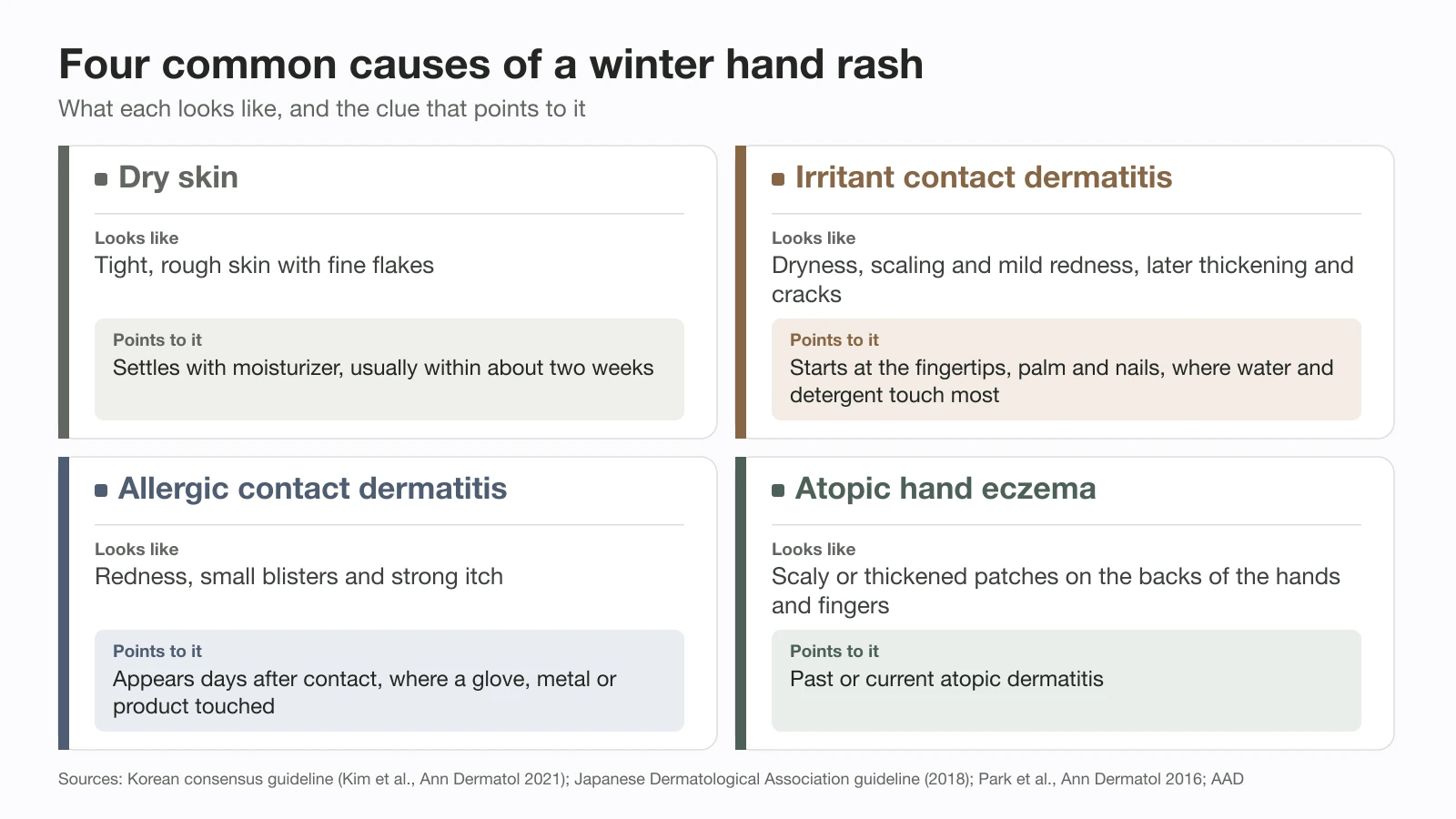
Dry skin. Tight, rough skin with fine flakes, without much redness, blistering or weeping. The American Academy of Dermatology (AAD) lists dry, chapped skin as often the first sign of hand eczema, so dryness that does not settle deserves a second look.
Irritant contact dermatitis. Damage from repeated contact with irritants such as water, soap and detergent over a long time. The Japanese guideline puts it at about 70% of hand eczema. It starts where the irritation lands, often the fingertips and palm of the dominant hand and the skin around the nails, as dryness, scaling and mild redness, and later thickens and cracks. Park et al. describe it between the fingers as well: itch can be mild, stinging, burning or pain are possible, and blisters are not typical.
Allergic contact dermatitis. A delayed allergy in someone already sensitized to a substance, usually appearing a few days after contact. Compared with irritant dermatitis, the Japanese guideline describes stronger redness, small blisters and more itch, starting where the allergen touched (the fingertips, the base of the thumb, the back of the hand) and sometimes reaching the wrists and forearms. Chemicals used to make rubber gloves are a recognized cause, as are latex and metals in jewelry (AAD, dry hands or hand eczema). The diagnosis rests on a positive patch test together with real contact with that substance (Korean guideline).
Atopic hand eczema. Chronic hand eczema in people with past or current atopic dermatitis, without a relevant irritant or allergen behind it (Korean guideline). A weaker skin barrier also makes irritant hand eczema easier to develop (Japanese guideline). In a meta-analysis of 26 studies, Ruff et al. (2018, Br J Dermatol, PMID: 29172235) found that people with atopic dermatitis had about four times the odds of hand eczema in the past year (odds ratio 4.29), and around a third of people with hand eczema in Quaade's review had a history of atopic dermatitis.
| Type | What it looks like | What points to it |
|---|---|---|
| Dry skin | Tight, rough skin, fine flakes | Settles with moisturizer, usually within about two weeks |
| Irritant contact dermatitis | Dryness, scaling and mild redness, later thickening and cracks | Starts where water and detergent touch most: fingertips, palm, around the nails |
| Allergic contact dermatitis | Redness, small blisters, strong itch | Appears days after contact, where a glove, metal or product touched; can reach the wrists |
| Atopic hand eczema | Scaly or thickened patches, often on the backs of the hands and fingers | Past or current atopic dermatitis |
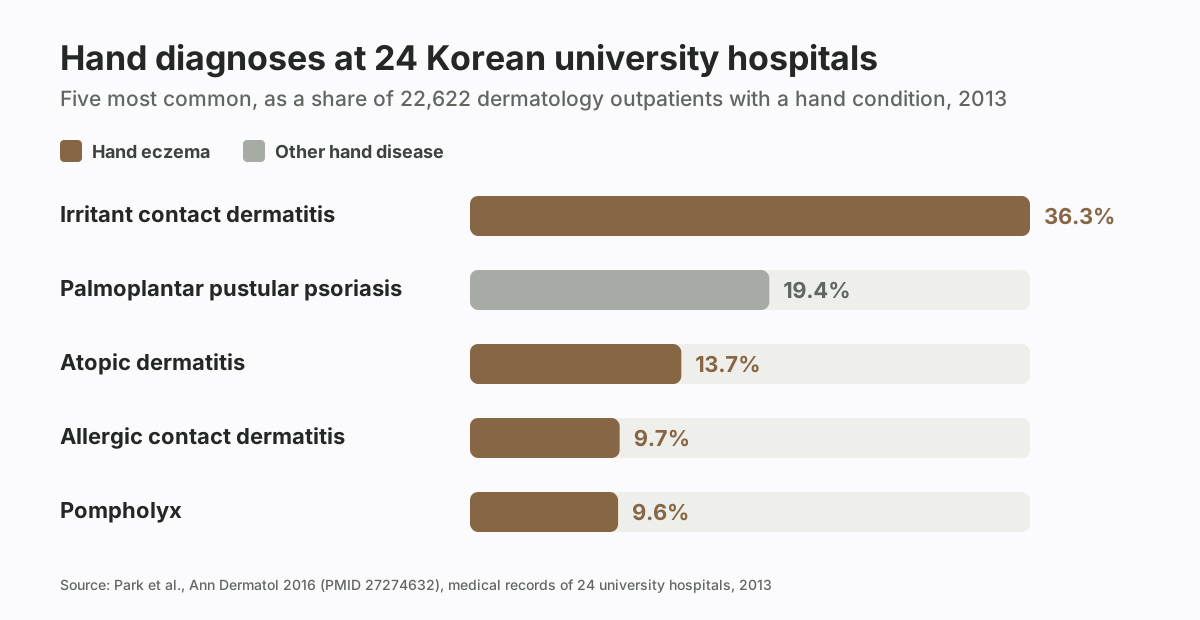
Not every rash on the hands is eczema. In Park's review of 22,622 dermatology outpatients with a hand condition at 24 Korean university hospitals in 2013, irritant contact dermatitis was the most common diagnosis (36.3%), but palmoplantar pustular psoriasis (19.4%) came second, ahead of atopic dermatitis (13.7%), allergic contact dermatitis (9.7%) and pompholyx, a recurrent blistering eczema of the palms and fingers (9.6%). Fungal infection, scabies and psoriasis can also look like hand eczema, and the Japanese guideline notes that a fungal infection of the hand is often on one side only.
Who gets it: wet work at home counts too
The AAD notes that many people whose hands are wet through the day, such as nurses, hair stylists and plumbers, get hand eczema. Work outside a job counts as well. In Park's patient survey, health care workers (22.9%) and homemakers (19.5%) were the two largest groups. Health care workers most often suspected disinfectant (49.8%), while everyone else most often named detergent (19.0%). The authors point out that many women in their twenties also do a great deal of wet work at home, including caring for small children.
The Japanese guideline describes a fingertip type in which the pads of the first three fingers of the dominant hand dry out, roughen and lose their fingerprint lines, then crack. It is common in homemakers and hairdressers who do a lot of wet work. Both the Korean and the Japanese guideline put the higher rate in women down to exposure rather than biology: wet work at home, and jobs in which most workers are women.
What you can change at home
The Korean guideline treats three things as the base of care for everyone with hand eczema: protecting the skin, removing whatever is causing it, and using moisturizer generously. At home that comes down to a few habits.
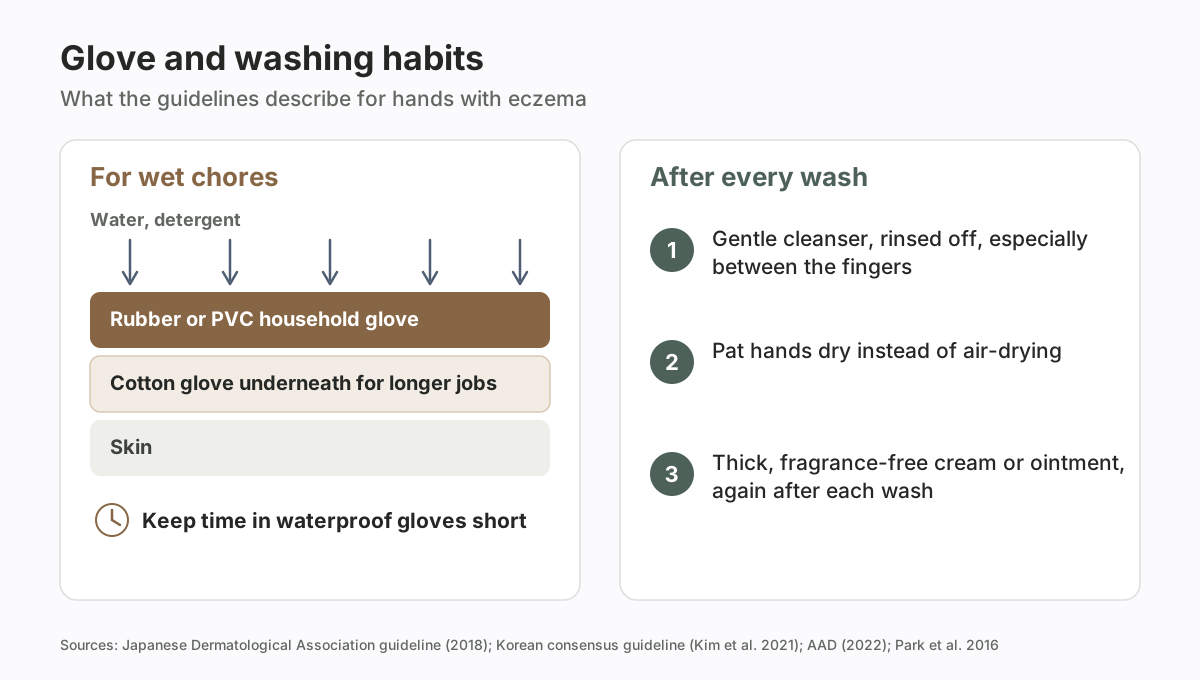
- Gloves for wet chores. The Japanese guideline suggests considering protective gloves for wet work, and household rubber or PVC gloves for washing up and cleaning.
- Cotton gloves underneath, and short sessions. Long hours in waterproof gloves can themselves irritate the skin, and the occlusion can aggravate skin that is already inflamed. The Korean guideline advises keeping time in occlusive gloves as short as possible, and the Japanese guideline recommends cotton gloves underneath when protective gloves are worn for a long time.
- Gentle washing. Use a gentle cleanser, avoid washing more often than you need to, rinse the cleanser off, especially between the fingers, and pat your hands dry rather than leaving them to air-dry (AAD).
- Moisturizer after every wash. A thick, fragrance-free cream or ointment rather than a lotion, applied often through the day (AAD), and again each time you wash your hands (Park et al.).
- Notice where it flares. If the rash sits exactly where a glove, ring or product touches, mention it at the visit. Rubber chemicals such as thiurams can cause allergic hand eczema (Korean and Japanese guidelines).
As for which moisturizer, the guidelines do not pick one. The Korean group found no data comparing formulations and made no recommendation on type, and the Japanese guideline's reading of the trials is that using a moisturizer regularly matters more than which one. For everyday dry-skin care through the cold months, see our autumn and winter moisturizing guide.
When to see a dermatologist
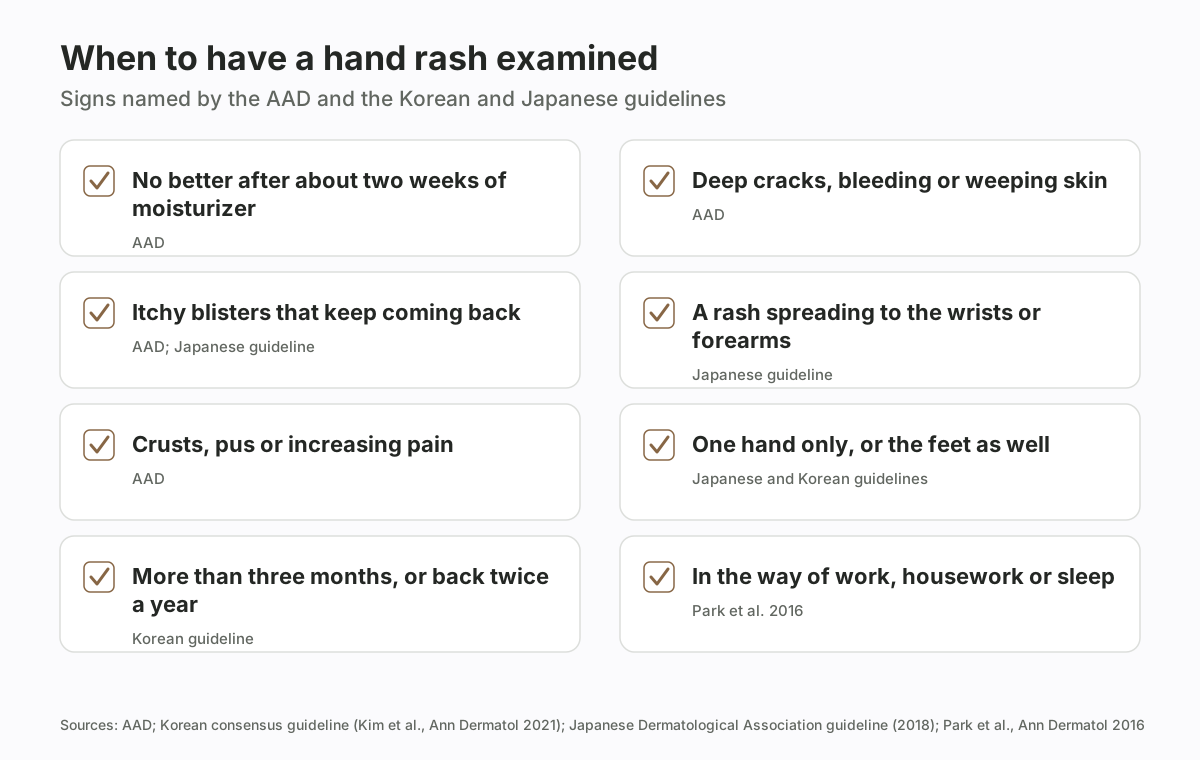
- Moisturizing through the day has not helped within about two weeks. The AAD notes that dry-skin care, when it works, tends to show improvement within two weeks, and that dry, painful hands that do not respond to moisturizer may be hand eczema.
- Deep, painful cracks, or skin that bleeds or weeps. Both are on the AAD's list of hand eczema signs.
- Itchy blisters, especially if they keep coming back on the palms and the sides of the fingers.
- A rash that spreads beyond where things touch, for example to the wrists or forearms, which the Japanese guideline describes in allergic contact dermatitis.
- Crusts, pus or increasing pain. These are on the AAD's list too, and the AAD warns that untreated hand eczema can become infected, including cellulitis, a potentially serious bacterial skin infection.
- A rash on one hand only, or one that also involves the feet. A fungal infection and other look-alikes need to be told apart.
- A rash lasting more than three months, or returning twice a year or more. The Korean guideline calls this chronic hand eczema.
- Hands that get in the way of work, housework or sleep. In Park's survey, 67.0% said hand eczema negatively affected daily activities such as work, exercise and housekeeping, and 47.0% linked it to low mood and poor sleep.
What a dermatology visit usually involves
Most of the work is asking and looking. The Korean guideline calls a full history and examination essential for everyone with chronic hand eczema: how the rash started and changed, what makes it better or worse, how often it comes back, what your hands touch at home and at work, hobbies, how often your hands are wet, and any personal or family history of atopic dermatitis, asthma or allergic rhinitis. The dermatologist also looks at the rest of your skin, especially the feet, to tell hand eczema apart from the look-alikes above.
Tests are chosen case by case. Patch testing looks for a delayed allergy: small amounts of common allergens, and where relevant your own products, are placed on the skin and read over the following days. The Korean guideline recommends it when the rash looks allergic or has lasted more than three months, and notes that a negative result does not completely rule out an allergy. Scrapings or swabs for fungi or bacteria may be taken when the rash suggests infection. Whether any of these is needed is the dermatologist's decision at the visit.
Treatment is built in steps on the three basics above. The Korean guideline names topical corticosteroids as the local treatment of choice, and further options are kept for severe chronic hand eczema that does not respond. The same guideline notes that corticosteroids work well for short courses, but that thinning of the outer skin (epidermal atrophy) and slower skin recovery limit their long-term use. Park et al. found that 53.0% of the patients they surveyed managed and protected their hands never, rarely or only sometimes after diagnosis, a gap the authors link to eczema becoming chronic.
Bring what helps the dermatologist find the cause: the gloves, soap, hand cream and any products you use at work, photographs of the rash on its worst days, and a rough timeline of when it started and what changed. If your face is dry or irritated as well, our guide to autumn dry skin or dermatitis covers the signs there. To have a winter hand rash examined while you are in Seoul, you can book a consultation.
Questions readers ask
Is hand eczema the same as dry hands?
Not quite. Dry, chapped skin is often the first sign of hand eczema, but eczema adds redness, scaling, itch, blisters or deep cracks, and it often does not settle with moisturizer alone.
Why does hand eczema get worse in winter?
Cold, dry air weakens the skin barrier and makes skin react more to irritants such as detergent and to allergens, and indoor heating dries it further. Winter was also the season of worst symptoms that Korean patients with hand eczema named most often.
Should I wear rubber gloves for dishes and cleaning?
Gloves are worth considering for wet work, as the Japanese Dermatological Association's guideline suggests. If the rash appears where the gloves touch, mention it at the visit: rubber chemicals can cause allergic contact dermatitis.
Why won't my hand eczema go away?
Continued contact with an irritant or allergen, and too little treatment, can keep hand eczema going. Hand eczema that lasts more than three months or returns twice or more a year counts as chronic, and chronic hand eczema is often controlled rather than cured, so the aim is fewer and milder flares.
Do I need a patch test?
Patch testing looks for a delayed allergy to something your hands touch. The Korean guideline recommends it when the rash looks allergic or has lasted more than three months. Whether you need one is decided at the examination.