Mon - Fri 10:00 - 20:00

Single-Visit Multi-Modality

One Day Spot Clear in Seoul | Laser Pigmentation Treatment

A single-visit, multi-modality protocol led by a board-certified dermatologist. Pico 532 nm targets discrete sun spots and age spots; Hollywood Spectra (Q-switched Nd:YAG) supports melasma toning and the Carbon Peel; CO2 fractional is reserved for thicker raised lesions; tranexamic acid mesotherapy is added for melasma-rebound control. Approximately 1-week recovery — shallow microcrusts form on treated lentigines and flake off over ~7 days.

Dr. SangYoul Yun
Reviewed by Dr. SangYoul Yun
Board-certified Dermatologist · Chief Director · AAD Member
01

Overview

Spot Clear combines targeted laser treatment with adjunctive care to address sun spots, age spots, and uneven tone in one carefully sequenced visit. Designed for patients who want a clear, dermatologist-led plan rather than a generic same-day promo. Most treated lesions form a thin microcrust within 24 hours and flake off over the following 5–7 days, after which the brightening becomes visible.

Best for

  • discrete sun spots (solar lentigines)
  • age spots and seborrheic keratoses
  • post-inflammatory hyperpigmentation from acne
  • uneven tone from accumulated sun damage
  • melasma (managed long-term with toning + tranexamic acid)

Suited for

  • patients with discrete pigmented lesions rather than diffuse melasma
  • travelers who can build in 5–7 days for crust resolution before key events
  • patients with prior failed laser treatment seeking a more conservative protocol
  • patients wanting a single-clinic, single-dermatologist plan
Duration
1-2 hours (consultation + treatment)
Sessions
1 visit + optional melasma adjunct course
Downtime
~1 week microcrust resolution
Peak result
2-4 weeks (after crust resolves)
02

Timeline

  1. Immediately post

    Mild redness and darkening of treated spots; shallow microcrusts begin forming within hours.

  2. Day 1-2

    Thin microcrusts visible on treated lentigines; treated areas appear darker before they lighten.

  3. Day 5-7

    Microcrusts flake off naturally; underlying skin appears noticeably brighter with reduced pigment.

  4. Week 2-4

    Brightening becomes more visible as residual erythema settles. Sun protection is critical to prevent post-inflammatory hyperpigmentation.

  5. Ongoing (melasma adjunct)

    If tranexamic acid mesotherapy is included, melasma rebound is reduced over a 4–6 session protocol at 2-week intervals.

03

Devices

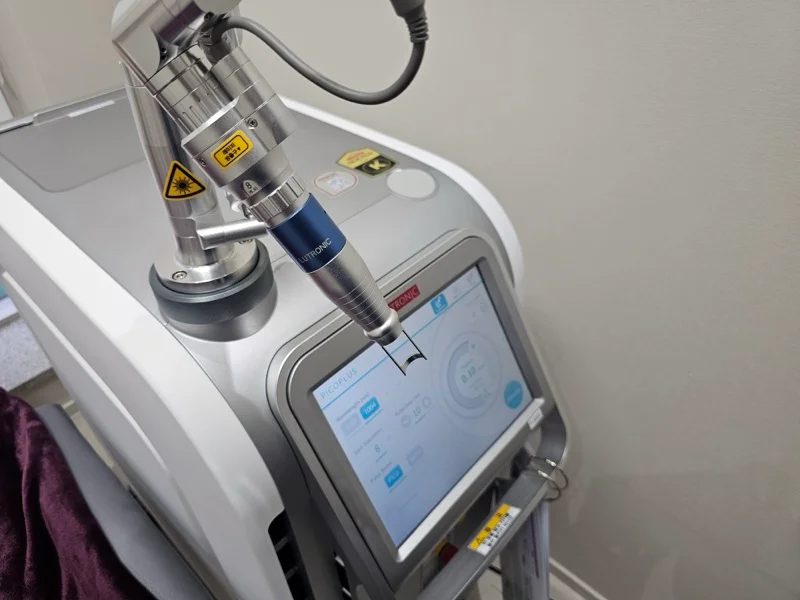
Lutronic PicoPlus picosecond laser at 532 nm wavelength

PicoPlus 532 nm

LutronicFDA 510(k) cleared

Key specs

Picosecond pulse duration (~450 ps) at 532 nm KTP-doubled output
Selectively absorbed by superficial epidermal melanin in lentigines and freckles
Photomechanical fragmentation — energy converts to shockwave rather than heat, reducing PIH risk on Asian skin
Typical session
5–10 minutes for face spots
Topical anesthesia not required
Shallow microcrusts form within 24 hours; flake off over 5–7 days
Hollywood Spectra (Spectra XT)

LutronicFDA 510(k) cleared Q-switched Nd:YAG

Key specs

Wavelengths
1064 nm and 532 nm Q-switched Nd:YAG, nanosecond pulses
Indications
melasma toning (low-fluence 1064 nm) and Hollywood Carbon Peel
Carbon Peel
thin carbon lotion applied; 1064 nm pulse selectively ablates carbon to clear pores and brighten
Typical Carbon Peel session
5–10 minutes; no anesthesia, immediately social
Often combined with Pico 532 nm in the same visit for layered pigmentation care
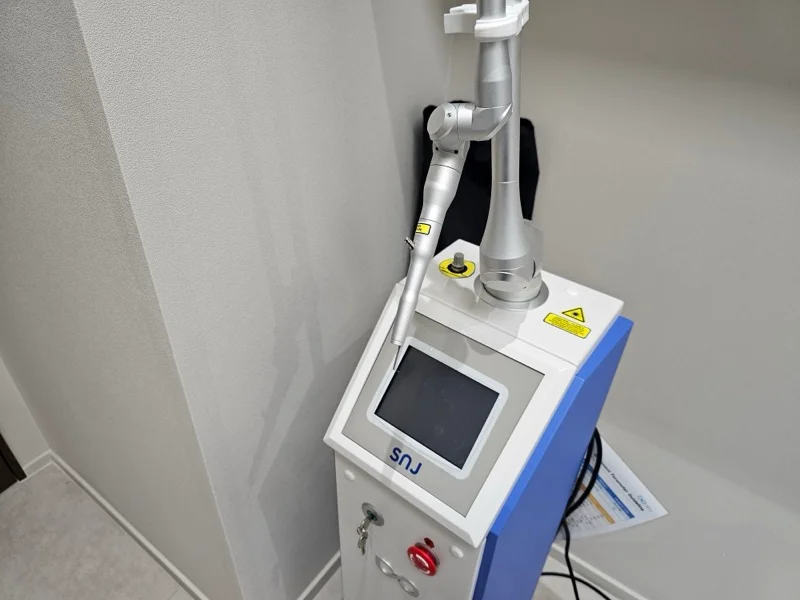
CO2 fractional laser system

CO2 fractional laser

FDA 510(k) cleared fractional ablative CO2

Key specs

10,600 nm ablative wavelength absorbed by tissue water
Reserved for thicker, raised seborrheic keratoses or stubborn lentigines that pico cannot fully clear
Typical session
10–20 minutes
Recovery
~1 week — pinpoint crusting and erythema
Result effectively permanent for treated lesions, though new lesions can form with sun exposure
Sun protection is non-negotiable post-CO2

Tranexamic acid mesotherapy

Compounded — pharmaceutical-grade tranexamic acidOff-label dermatologist-supervised use; tranexamic acid is a Korean MFDS-approved oral and topical agent

Key specs

Intradermal microinjections of tranexamic acid
Inhibits the plasminogen–plasmin pathway implicated in melasma pigment overproduction
Adjunctive — used alongside laser toning to reduce melasma rebound
Typical session
10–15 minutes
No downtime; mild pinpoint redness for hours
Most effective as a 4–6 session protocol at 2-week intervals
04

Process

  1. 01

    Board-certified dermatologist examines pigmentation type, depth, and skin response history

  2. 02

    Laser device and settings are selected based on spot type and skin tone — Pico 532 nm for discrete lentigines, Q-switched 1064 nm toning for melasma, CO2 fractional reserved for thicker raised lesions

  3. 03

    Targeted laser treatment is applied to pigmented areas; tranexamic acid mesotherapy may be added as a melasma-rebound adjunct

  4. 04

    Post-treatment calming care and sun protection are applied

  5. 05

    Complete in 1-2 hours including consultation and post-care; treated spots form a thin microcrust within 24 hours that flakes off over 5–7 days

05

Aftercare

  1. 01First 24 hours

    Microcrusts begin forming on treated spots. Apply prescribed soothing balm; avoid touching, scrubbing, or picking. No hot showers, saunas, or vigorous exercise.

  2. 02Days 1-7

    Microcrusts flake off naturally over 5–7 days. Do NOT pick or peel — premature removal increases PIH risk. Cleanse gently; pat dry. Apply broad-spectrum SPF 50+ daily.

  3. 03Weeks 2-4

    Strict sun protection (SPF 50+, hat, shade). Avoid retinoids and exfoliating acids until full re-epithelialization. Resume normal skincare gradually.

  4. 04Long-term (melasma cases)

    Daily SPF, vitamin C / niacinamide topicals, and adherence to the tranexamic acid mesotherapy protocol where prescribed. Photographic follow-up at the clinic helps gauge rebound risk.

06

FAQ

How is Spot Clear different from melasma treatment?

Spot Clear targets discrete pigmented lesions (sun spots, age spots) that respond well to single-session laser treatment. Melasma is a chronic condition managed long-term with low-fluence toning and adjuncts such as tranexamic acid mesotherapy.

Will the spots come back after treatment?

Treated spots are permanently removed, but new spots can form with continued sun exposure. Consistent sunscreen use is the best prevention.

Can I fly the same day after treatment?

The treated spots form a thin microcrust within 24 hours that typically flakes off over 5–7 days. Flying the same day is physically possible, but most patients prefer to wait until the crust has resolved before being photographed in their home country. The dermatologist will discuss timing during consultation.

Notice

Tell the dermatologist at consultation if any of the following apply.

  • Active skin infection or open wound in the treatment area
  • Pregnancy or lactation (relative — tranexamic acid mesotherapy and elective laser deferred)
  • Recent isotretinoin use within 6 months (relative — increases scarring risk for ablative CO2)
  • Personal or family history of keloid scarring (relative — requires dermatologist review)
  • Active herpes simplex in the treatment zone (requires antiviral prophylaxis before treatment)
  • Photosensitizing medication use (review with dermatologist before laser)

For your visit

  • Approximately 1-week recovery — shallow microcrusts form on treated lentigines and flake off over ~7 days
  • Mild redness and darkening of treated spots is normal during the 5–7 day microcrust window
  • Strict sun protection is essential for 2-4 weeks post-treatment
  • Transparent KRW Seoul pricing — quoted after consultation
07

References

The clinical claims on this page — device specs, efficacy timelines, safety profile — are supported by the primary sources below. Each citation links to the original paper or regulatory record.

  1. [1]Oral Tranexamic Acid for the Treatment of Melasma: A Review. Dermatol Surg (Bala HR et al., PMID 29677015) (2018).
  2. [2]Comparing the efficacy of topical hydroquinone 2% versus intradermal tranexamic acid microinjections in treating melasma: a split-face controlled trial. J Dermatolog Treat (Saki N, Darayesh M, Heiran A, PMID 29027510) (2017).
  3. [3]Therapeutic efficacy and safety of oral tranexamic acid and that of tranexamic acid local infiltration with microinjections in patients with melasma: a comparative study. Clin Exp Dermatol (Sharma R, Mahajan VK, Mehta KS, Chauhan PS, Rawat R, Shiny TN, PMID 28649780) (2017).
Reviewed byDr. SangYoul Yun· Board-Certified Dermatologist · AAD International Fellow (IFAAD)· Last reviewed 2026-05-05

Related procedures

Notice: Individual results may vary depending on skin condition, treatment history, and recovery factors. All treatment plans are determined through individual consultation with a board-certified dermatologist. The information on this page is for reference only and does not constitute medical advice or guarantee specific outcomes.

Next Step

You can start with a short message before deciding on Spot Clear.

Even a short first message can help you check suitability, timing, and what to compare next before you book.

Gangnam, Seoul

Personalized dermatology care in Gangnam for local and overseas patients.

Delight Dermatology Clinic focuses on doctor-led consultation, warm service, and personalized treatment planning.

Walking videos

Nonhyeon · Exit 4
Sinnonhyeon · Exit 2
Clinic

Delight Dermatology Clinic

4th Floor, Building B, 509 Gangnam-daero

Seocho-gu, Seoul, South Korea

Parking is available in the building.

02-517-9991

Mon - Fri: 10:00 - 20:00

Lunch break: 13:00 - 14:00

Saturday: 10:00 - 16:00

Sunday and public holidays: Closed

Location

Gangnam · Seocho-gu, Seoul

Find directions

Clinic Name: 딜라이트피부과의원Representative: 윤상열Tel. 02-517-9991Business Registration No.: 357-15-02460Privacy PolicyTerms of Use
Registered Foreign Patient Medical Institution
Officially registered by the Ministry of Health and Welfare of the Republic of Korea (Reg. No. M-2024-01-08-8248) · 외국인환자 유치의료기관

Medical information on this site is for reference only and does not constitute medical advice. Individual results may vary. Consult a board-certified dermatologist for diagnosis and treatment planning.