Non-surgical Lifting
Ultherapy Prime
Ultherapy Prime in Gangnam by a board-certified dermatologist. FDA-cleared non-surgical lifting for jawline, neck, and brow — same-day treatment available.
Clinical Comparison
Ultherapy vs Korean HIFU devices — FDA data, clinical trials, and meta-analyses compared. Which lifting device fits your goals? Evidence-only guide.
Your Journey
Ultherapy vs Korean HIFU devices — FDA data, clinical trials, and meta-analyses compared. Which lifting device fits your goals? Evidence-only guide.

Both Ultherapy and medical HIFU use the same core principle: focused ultrasound energy creates thermal coagulation points (TCPs) at precise tissue depths, heating tissue to 60–70 °C. This causes immediate collagen contraction and triggers a wound-healing response that produces new collagen over 2–6 months.
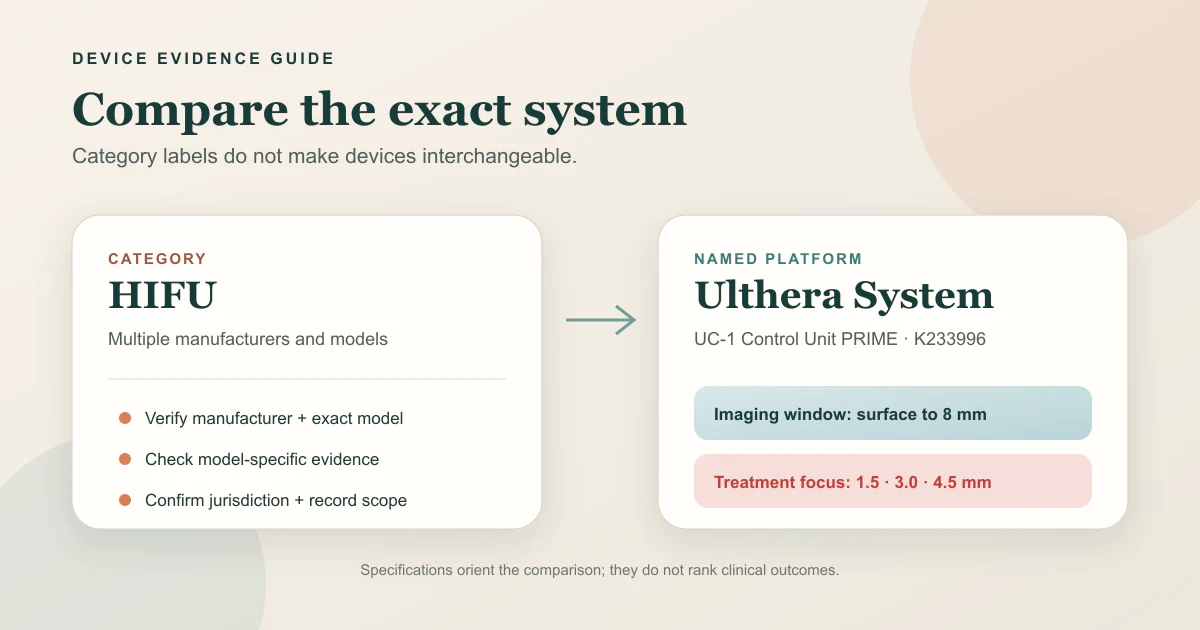
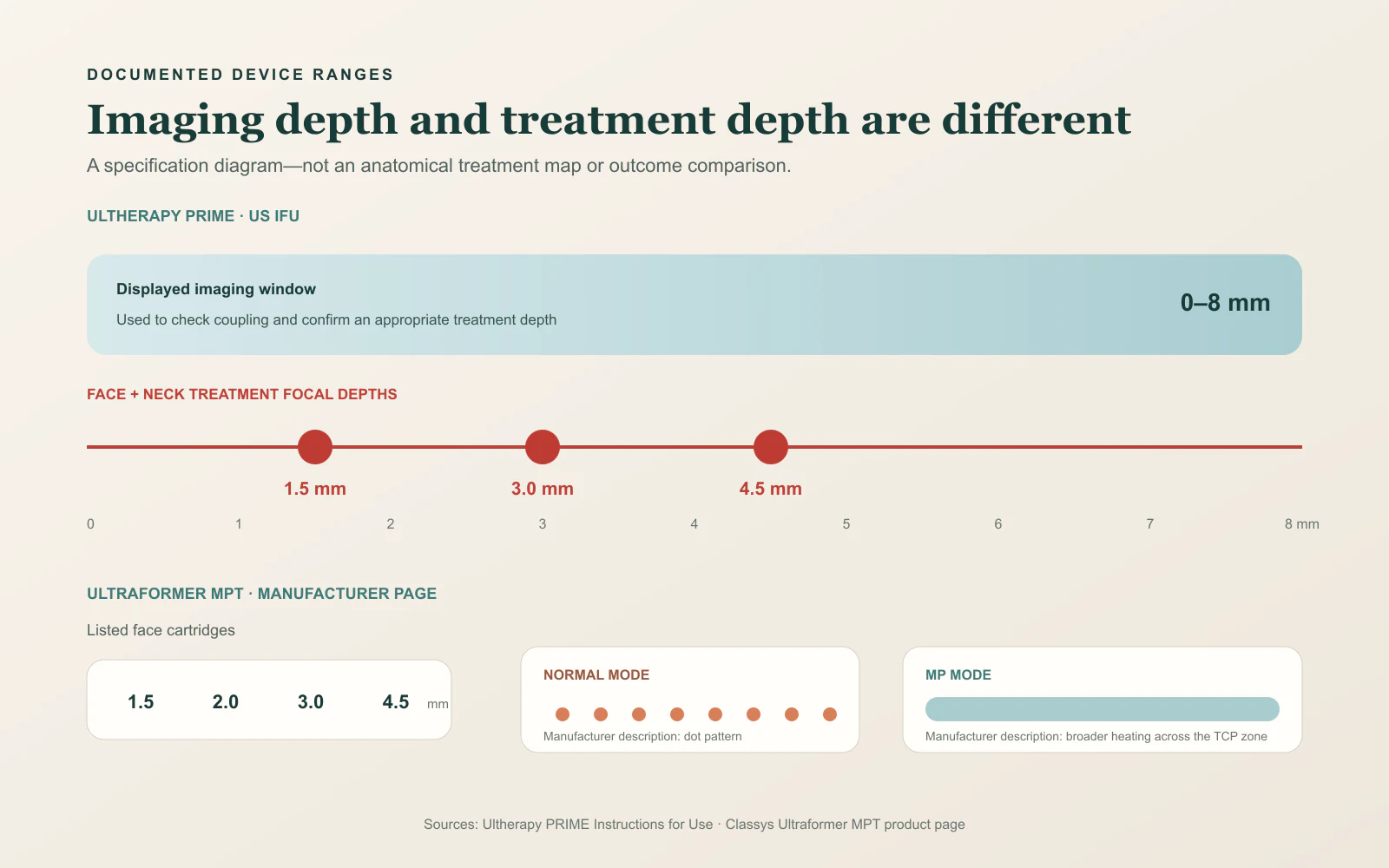
The key targets are three tissue layers: the superficial dermis (1.5 mm), deep dermis (3.0 mm), and the SMAS layer (4.5 mm) — the same fibromuscular layer surgeons tighten in a facelift. By reaching the SMAS non-invasively, focused ultrasound achieves a degree of structural lifting that surface-only treatments cannot.
A 2020 meta-analysis of 17 studies (Ayatollahi et al., Lasers in Medical Science, PMID: 32026164) found an average objective improvement score of 2.74/5 and a subjective satisfaction score of 2.68/5 across all HIFU treatments — moderate but consistent improvement with a favorable safety profile.
Ultherapy (micro-focused ultrasound with visualization, MFU-V) is the only ultrasound device with FDA 510(k) clearance for non-invasive skin lifting. Its regulatory history spans over 15 years:
The defining feature is DeepSEE visualization — real-time ultrasound imaging to 8 mm depth, allowing practitioners to see tissue layers, nerves, and vessels before and during treatment. No other HIFU device has this integrated imaging.
Key clinical evidence:
An important caveat: Chang et al. (2019, Lasers Surg Med, PMID: 30664263) found that when patients were surveyed anonymously, satisfaction dropped to 53.1% — significantly lower than the 80–95% reported in non-anonymous studies. Many published Ultherapy studies also involve authors with financial ties to the manufacturer (Merz Aesthetics). These factors should be considered when interpreting published efficacy rates.
South Korea has developed its own ecosystem of HIFU devices, approved by MFDS (Korea's FDA equivalent) but not FDA-cleared in the United States. The major devices include:
Ultraformer MPT (branded as Shurink Universe) — manufactured by Classys, reported as the No. 1 player in the Korean HIFU device market. The 4th-generation device uses micropulsed technology, creating 417 micro-coagulation points per line (vs. 17 in previous generations), reducing treatment time and reported pain. Available depths: 1.5, 2.0, 3.0, 4.5 mm.
Kim (2024, PRS Global Open, DOI: 10.1097/GOX.0000000000006203) measured outcomes in 50 patients using 3D scanning: jaw 2.90 mm, neck 3.53 mm, malar 2.46 mm lifting — all statistically significant (P < 0.05).
Doublo Gold — manufactured by Hironic, with over 1 million clinical cases since 2011. Uses bidirectional firing for faster treatment. CE-marked and widely used across Asia.
The FDA gap explained: Korean devices lack FDA clearance not because they were rejected, but because their manufacturers have not pursued the US regulatory pathway. The 510(k) process requires substantial clinical data, and the Korean and Asian markets are large enough to sustain these companies without US clearance. This is a regulatory path difference, not necessarily an efficacy or safety judgment.
Park et al. (2015, Annals of Dermatology, PMID: 26719637) studied HIFU in 20 Korean patients: greatest improvement in jawline and cheek regions at 3 and 6 months, with only mild, transient side effects. The evidence base for Korean HIFU devices is growing but remains substantially smaller than Ultherapy's 50+ published studies.
There are no published head-to-head clinical trials directly comparing Ultherapy with any Korean HIFU device. All comparisons in the literature are indirect, based on separate studies with different methodologies, patient populations, and outcome measures. This is the single most important fact in this entire guide.
What we can compare from available data:
| Ultherapy (MFU-V) | Korean HIFU (Ultraformer, Doublo) | |
|---|---|---|
| Real-time imaging | Yes (DeepSEE) | Generally no |
| Regulatory status | FDA-cleared (US) | MFDS-approved (Korea), CE-marked (EU) |
| Session duration | 60–90 min (full face) | 20–40 min |
| Pain (mean score) | ~4.85/10 | Lower (newer models) |
| Typical protocol | 1 session, repeat in 1–2 years | 2–3 sessions, every 6–12 months |
| Published evidence | 50+ peer-reviewed studies | Growing but substantially less |
| Price in Seoul | Higher (approx. 2–3×) | Lower |
Safety across both categories: The 2025 meta-analysis (Haykal et al., Aesthetic Surgery Journal, PMID: 40184185) reviewing 45 clinical trials found fewer than 5% experienced transient erythema, swelling, or mild discomfort. Rare complications — including nerve injury, fat atrophy, and burns — have been documented (Friedmann et al., 2018, Lasers Surg Med, PMID: 29154457) and are typically associated with improper device settings or technique.
"Which is better?" is not the right question. Both technologies use focused ultrasound to reach the same tissue targets. The better question is which approach fits your specific situation:
The ideal scenario is consulting at a clinic that offers both options and can recommend based on your anatomy, goals, and maintenance preferences — rather than a clinic that only carries one device and presents it as universally best.
At Gangnam Delight Dermatology, we use both Ultherapy and Korean HIFU devices. The choice is made during consultation based on individual assessment, not device loyalty.
FAQ
There are no head-to-head clinical trials comparing the two directly. Ultherapy has FDA clearance and a larger evidence base (50+ studies, 89% improvement in meta-analysis). Korean HIFU devices have MFDS approval and growing clinical evidence. Each has distinct advantages — Ultherapy offers real-time visualization, while newer Korean HIFU devices offer faster treatment with less reported pain. The best choice depends on your specific goals and preferences.
Yes. Park et al. (2015, Annals of Dermatology) specifically studied HIFU in Korean patients and found only mild, transient side effects (temporary redness in 6 of 20 patients, minor bruising in 2). The 2020 meta-analysis by Ayatollahi et al. reported no hyperpigmentation across all included studies. Both Ultherapy and Korean HIFU devices are widely used across Asia with favorable safety profiles.
Ultherapy studies report results lasting 1–2 years on average, with some patients maintaining improvement for longer. Werschler & Werschler (2016) found 95% of patients still showed improvement at 1 year. Korean HIFU protocols typically recommend sessions every 6–12 months for maintenance, which may reflect both the treatment approach and the Korean preference for regular aesthetic maintenance.
Korean HIFU manufacturers (Classys, Hironic) have not pursued FDA 510(k) clearance for the US market. The Korean (MFDS) and European (CE) regulatory pathways are separate from the US FDA. These companies focus primarily on Asian and European markets. The absence of FDA clearance reflects a business decision about regulatory pathway, not a rejection based on safety or efficacy concerns.
Yes. HIFU and Ultherapy are commonly combined with other modalities that target different tissue depths — for example, radiofrequency (Thermage) for the superficial dermis, or Botox for dynamic wrinkles. Combination protocols are increasingly common in clinical practice, though timing and sequencing should be determined by your treating physician based on individual assessment.
Related Procedures
If you need more detail about treatment approach, recovery, or suitability, continue into these procedure pages.

Non-surgical Lifting
Ultherapy Prime in Gangnam by a board-certified dermatologist. FDA-cleared non-surgical lifting for jawline, neck, and brow — same-day treatment available.

Solta Medical · AccuREP Technology
Thermage FLX in Gangnam, Seoul. AccuREP real-time feedback, Comfort Pulse, board-certified dermatologist. Over two decades of clinical evidence.

Periorbital Tightening
Eye Thermage treatment in Seoul for under-eye laxity, crow's feet, and eyelid support with doctor-led treatment planning in Gangnam.

Anti-Aging Package
Neck tightening package in Seoul — Botox for platysmal bands plus filler for neck creases. Board-certified dermatologist in Gangnam.