
The Wedding Skin Timeline: Working Backward from Your Date
Which treatment belongs 90, 60, 30 and 7 days before a wedding, and which ones to stop scheduling entirely. A dermatologist-clinic timeline built around real recovery and peak-effect windows.
Wedding skin requires careful scheduling above all else. Almost everything a dermatology clinic offers can look wonderful at a wedding, if it is timed from the date backward. The same treatments booked emotionally, in the final weeks, are how brides end up photographed mid-recovery. This is the working-backward timeline we use in consultations, built on each treatment's own recovery and peak-effect window.
The one rule that organizes everything
Every procedure has two clocks: a recovery window (redness, swelling, bruising, flaking) and a peak window (when the result reads best). Wedding planning means placing each treatment so the recovery clock finishes early and the peak clock lands near your date. Both clocks vary by person, which is exactly why the plan starts with a consultation, not a shopping list.
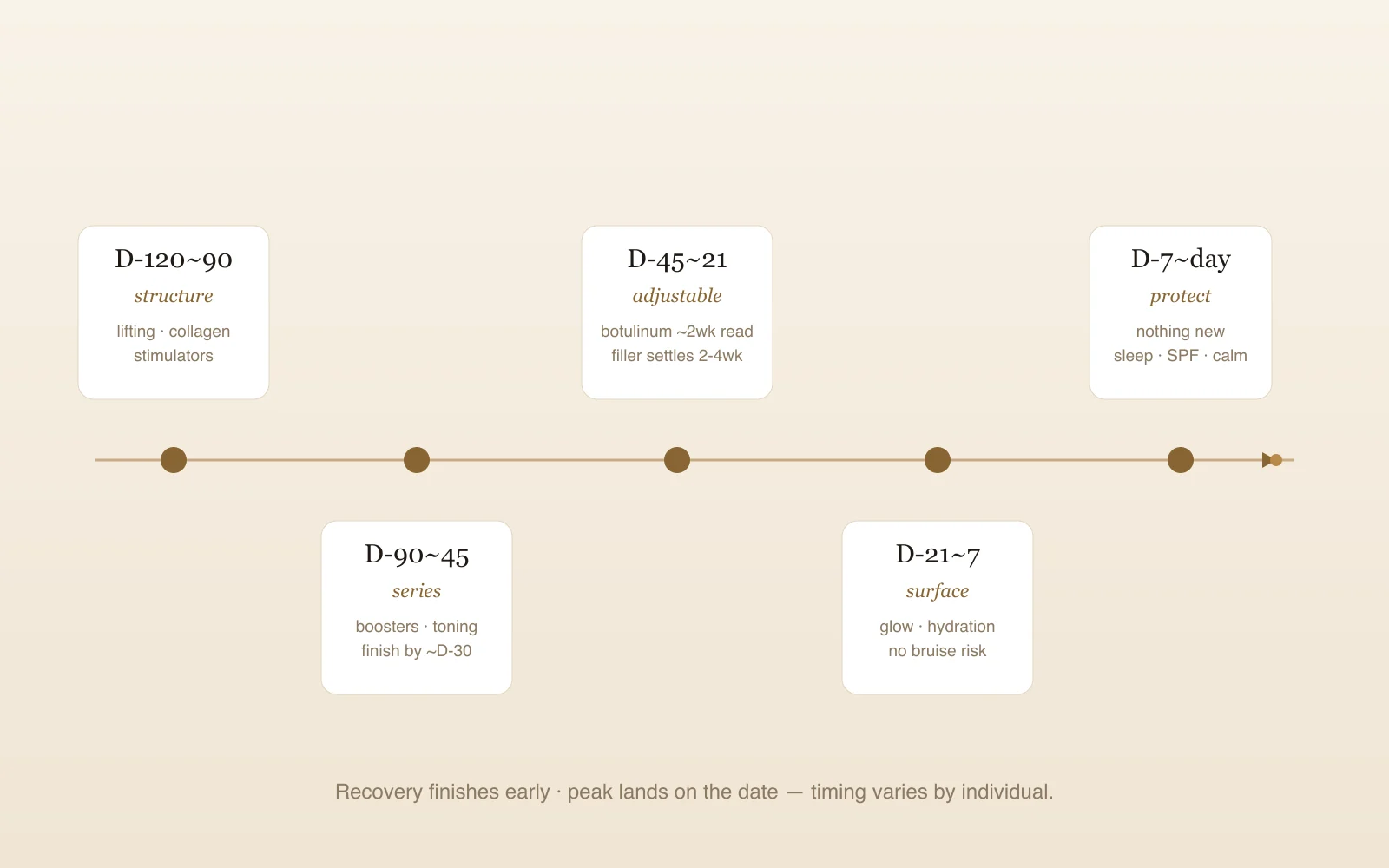
D-120 to D-90: structural decisions
If lifting or firmness is on your wish list, this is its window, because energy-based results build slowly: Ultherapy and Thermage responses are typically assessed around the three-to-six-month mark, and Sofwave around three months. Treated at D-90 or earlier, the remodeling curve has time to develop; treated at D-30, it mostly hasn't. Collagen-stimulating injectables such as Sculptra build over multiple sessions and months, so they belong here too, or should realistically be deferred until after the wedding if the calendar has already moved past this window.
D-90 to D-45: series treatments
Treatments that work as a course: Rejuran and other skin boosters, laser toning for pigmentation, scar programs, need their sessions spaced weeks apart, and their small recovery bumps (papules for a day or two after PN injections, transient redness after toning) need to stop happening well before the dress fittings and pre-wedding shoots. Start the series here so the final session lands no later than about a month out, with one honest caveat: Rejuran's full-course result is typically read eight to twelve weeks after the induction course, so a series finishing at D-30 may show its complete effect after the wedding rather than at it. Started at D-90, the math works; started later, expectations should be adjusted accordingly. Anything with real downtime (subcision, fractional resurfacing) should finish in this window, not start after it.
D-45 to D-21: the adjustable window
HA filler belongs at the early end of this window (around D-45 to D-30): its final look is assessed two to four weeks after the swelling settles, so placed here it has time to look like you, not like the procedure. Light hydration boosters such as SkinVive, whose result is typically assessed around a month, sit best here too. Botulinum toxin typically reads at around two weeks, which makes roughly three to four weeks out its comfortable slot: settled result, natural expression in photos, and margin left for a touch-up review. The closer any of these move toward the date, the less room remains to adjust.
D-21 to D-7: surface, not structure
This stretch is for glow, hydration and calm: gentle, familiar facials and disciplined home care, nothing structural, nothing injectable, nothing with a bruising risk you would need to explain to a photographer. Treatments whose result is read in weeks belong in the earlier windows, not here.
D-7 to the day: the do-nothing-new week
The final week has one job: protect what was built. No new treatments, no first-time products, no experimental facials: a new cosmetic introduced days before a wedding is the classic route to a reactive flare. The final week belongs to familiar skincare, sun protection, sleep and hydration, not to a last-minute procedure.
Two important notes for the compressed calendar
- If your wedding is 4–6 weeks away, it is generally too late to expect a structural treatment's full result by the date, and a good clinic will say so. What still fits: botulinum toxin with a margin, conservative surface work, and a plan that resumes properly after the honeymoon. Squeezing a three-month treatment into three weeks buys the recovery, not the result.
- Individual variation is crucial. The windows above restate typical values from our procedure pages; your skin, your history and your photographer's schedule can move every one of them. That is what the consultation is for.
For international brides planning around Seoul trips
The timeline maps cleanly onto a two-trip pattern: a first Seoul visit around D-90 for the structural and series decisions, and a second around D-30 for the adjustable layer. If only one trip is possible, earlier beats later: the treatments that require early scheduling are the ones that cannot be rushed. Our trip planner covers recovery-aware itineraries in detail.
Key takeaways
- Plan from the date backward: structure by D-90, series done by ~D-30, adjustables by ~D-21, surface by D-7, nothing new after.
- Every window here restates the recovery and peak values published on the linked procedure pages, and every one varies by individual.
- The last week is maintenance, not opportunity.
FAQ
When should I book the consultation itself? Around D-120 if you can. The consultation is what turns this generic timeline into your timeline, and some windows close early.
Can I do botulinum toxin the week of the wedding? We advise against it: the result is still evolving during the first days and there is no margin left to adjust. Three to four weeks out is the comfortable slot.
What about a facial the day before? Only something your skin already knows well. The final week is the wrong time for any first encounter (products or procedures).
My wedding is in three weeks. Is it too late? Generally too late for a structural result to arrive by the date, not too late for polish. A conservative consultation can still place the safe pieces, and sequence the rest for after.
Disclaimer: This content is general information and not medical advice. Treatment selection and timing require an in-person assessment by a qualified dermatologist.
Lưu ý: Thông tin trong bài chỉ mang tính giáo dục chung, không thay thế tư vấn y khoa. Kế hoạch điều trị cá nhân được xác định qua buổi tư vấn với bác sĩ da liễu chuyên khoa. Kết quả có thể khác nhau.
Liệu trình liên quan