
Subcision for Acne Scars: What the Downtime Really Looks Like
Subcision releases the fibrous bands that pull rolling acne scars down. What the bruise timeline actually looks like, who should not have it, and how it pairs with fillers, lasers and RF microneedling.
Of all the acne-scar procedures, subcision is the one patients have usually heard the least about, and the one whose recovery they most want spelled out before committing. The short version: it is a brief, needle-based release procedure, and its downtime is dominated by one thing. Bruising. Planning for the bruising is the key to recovery.
What subcision actually does
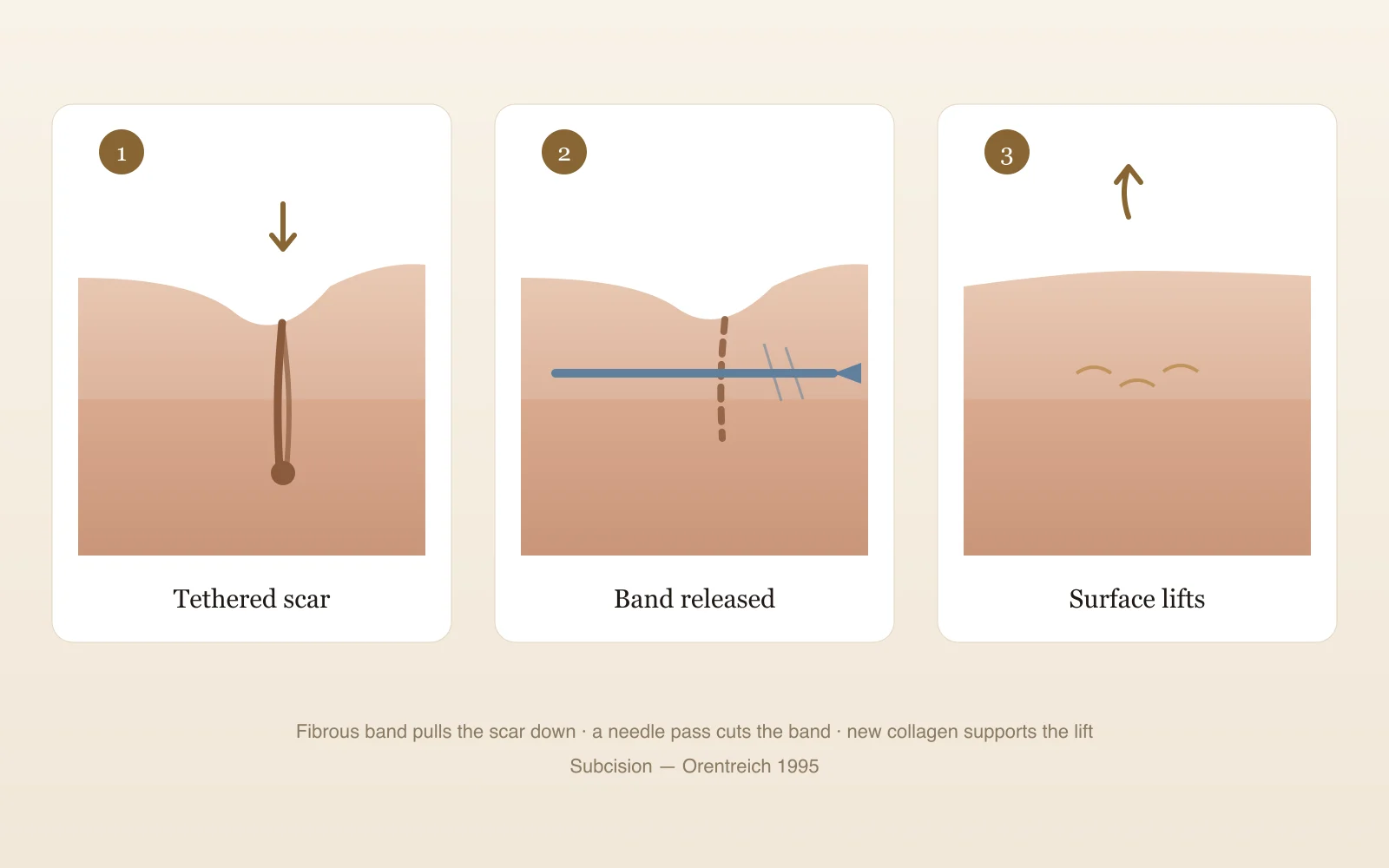
Rolling and some boxcar acne scars are not simply "dents." They are skin tethered from below: during scar healing, fibrous strands form between the underside of the skin and deeper tissue, and those strands pull the surface down like upholstery buttons. Creams cannot reach them and energy devices cannot cut them.
Subcision (subcutaneous incisionless surgery) was described by Orentreich and Orentreich in 1995: a special hypodermic needle enters through a tiny puncture and is moved beneath the scar to cut the tethering strands. The depression is lifted both by the mechanical release itself and by the new connective tissue that forms during normal wound healing (PMID 7773602).
The downtime timeline
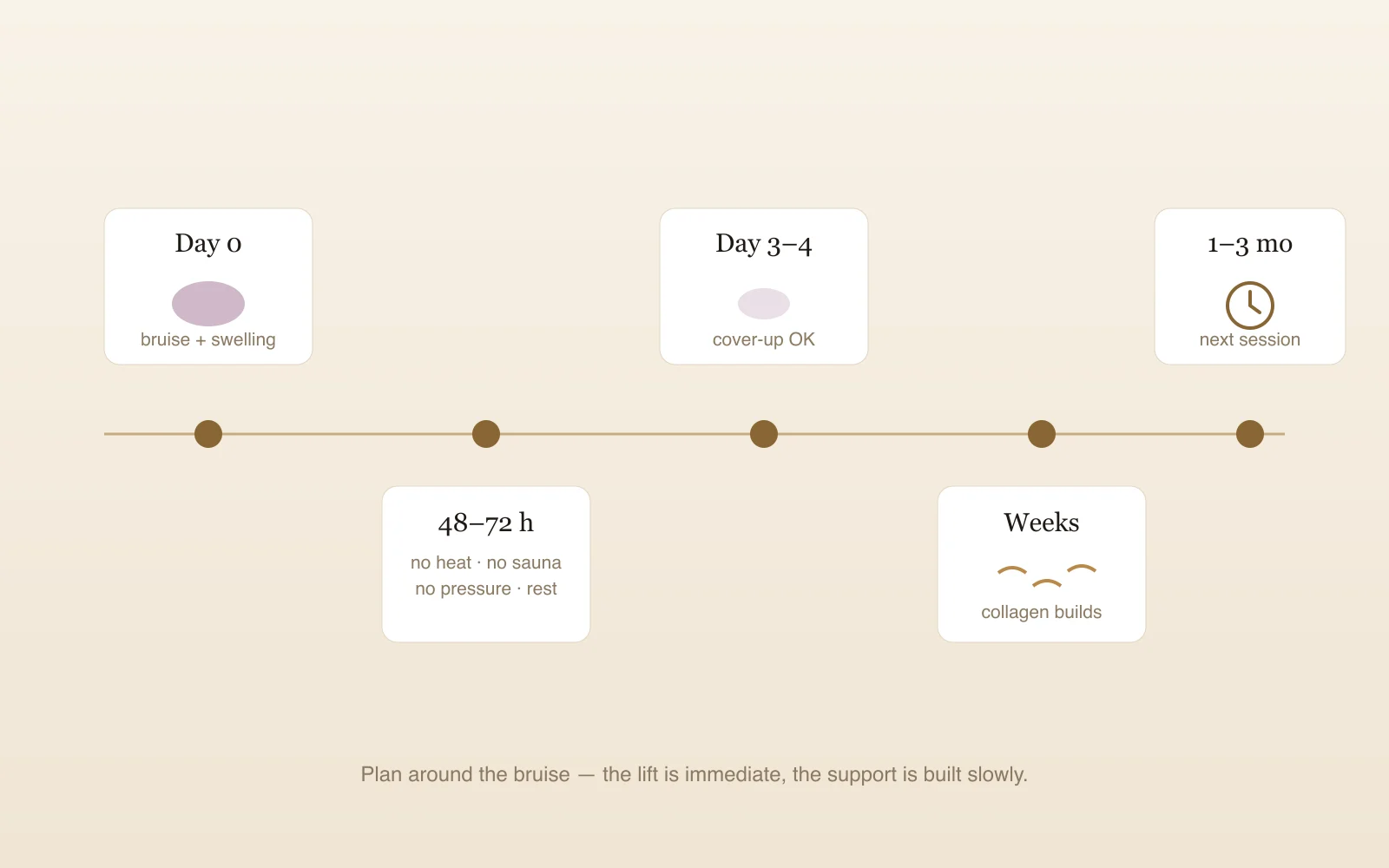
Subcision cuts tissue that contains small blood vessels, so mild bruising is a common, expected treatment effect. Marked, spreading or worsening bleeding or swelling is not part of that expectation and should be reviewed by the clinic promptly. At our clinic, the recovery pattern we counsel for the subcision component of an acne-scar program is:
- Immediately after: mild swelling and bruising at the released zone; the pinpoint entry marks settle over the first 24–48 hours.
- First 48–72 hours: avoid pressure on the treated area, hot showers, saunas, alcohol and vigorous exercise; sleeping with the head slightly elevated on the first night helps limit swelling.
- Days 3–4: bruising typically fades enough for daily life; concealer generally covers what remains once any entry points have closed.
- Weeks to months: the release is immediate, but the collagen that holds the lift builds gradually, which is also why sessions are spaced 1–3 months apart rather than stacked weekly.
Individual timelines depend on the number of scars released, the area treated and your own bruising tendency. The ranges above are planning guidance, not a guarantee.
Needle or cannula, and why it matters for recovery
According to a 2022 review of 16 clinical trials, needle-based and blunt-cannula subcision deliver comparable efficacy, but the cannula approach caused fewer side effects overall and higher patient satisfaction. How much bruising you personally get still varies with technique and your own tendency (PMID 36315903). A 2023 instruments review catalogues the wider toolkit (needles, cannulas, wires and blunt-blade devices) chosen by scar depth and distribution (PMID 36698445). Which tool suits your scars is determined during consultation, and it is fair to ask your dermatologist which one they plan to use and why.
Why subcision is usually combined with other treatments
Subcision releases the floor of the scar; it does not resurface its edges or rebuild lost volume. The strongest modern evidence supports using it in combination approaches. A 2026 Bayesian network meta-analysis pooling 56 randomized trials and 1,488 patients across 34 interventions found that combination approaches generally outperformed monotherapies for moderate-to-severe atrophic scars, with fractional CO2 laser plus subcision ranking among the most consistent performers for scar-score improvement and patient satisfaction (PMID 42429955).
This aligns with how we sequence scar treatments: subcision to release tethered rolling and boxcar scars (often layered with a collagen-stimulating injectable in the released plane so the lift holds), CO2 for scar-edge shaping where morphology calls for it, and RF microneedling where texture and shallow atrophy dominate. The mix follows the scar map drawn at consultation, not a fixed package.
Contraindications and precautions
- Bleeding disorders or anticoagulant medication without medical clearance, subcision works by controlled subdermal cutting, so this is a strict requirement reviewed before any session.
- Active acne or infection in the treatment area: settle the inflammation first so new scars are not forming alongside the repair.
- Keloid-prone healing: needs individual assessment, since subcision relies on the wound-healing response it triggers.
- An event within the same week: give the bruise its 3–4 days; subcision the day before a wedding is poor planning, not bad luck.
Key takeaways
- Subcision treats the cause of tethered scars (the fibrous bands), not just their appearance.
- Downtime primarily involves bruising: a few days of visible marks, cover-up from around day 3–4, and no reason to hide for weeks.
- Cannula techniques offer a meaningfully gentler recovery at comparable efficacy.
- Published evidence favors combination approaches; at our clinic, subcision sessions are generally spaced 1–3 months apart. Expect a program, not a single visit.
FAQ
Does subcision hurt? The area is numbed with local anesthesia first; most patients describe pressure and a snapping sensation rather than pain. Tenderness afterward is usually mild and short-lived.
How many sessions will I need? It depends on how many scars are tethered and how they respond, sessions are planned 1–3 months apart, and the scar map is reassessed each time rather than sold as a fixed course.
Can I fly home a day or two after subcision? Flying itself is not the constraint: visible bruising is. International patients usually plan subcision at the start of a Seoul stay and keep the first 48–72 hours low-key; bruising can still be visible at day 1–2, so if your window is tight, ask for individual guidance before booking flights.
Is subcision safe for darker skin tones? Subcision does not resurface the epidermis, which is one reason it is considered across skin types, but bruising and pigment change can still occur, and any combination laser steps need settings chosen for your skin type.
Sources
- Orentreich DS, Orentreich N. Subcutaneous incisionless (subcision) surgery for the correction of depressed scars and wrinkles. Dermatol Surg. 1995;21(6):543-9. PMID 7773602 · DOI
- Ahramiyanpour N, et al. Subcision in acne scarring: a review of clinical trials. J Cosmet Dermatol. 2022;22(3):744-751. PMID 36315903 · DOI
- Vempati A, et al. Subcision for atrophic acne scarring: a comprehensive review of surgical instruments and combinatorial treatments. Clin Cosmet Investig Dermatol. 2023;16:125-134. PMID 36698445 · DOI
- Ou Y, et al. Laser, microneedling, and combination therapies for moderate to severe acne atrophic scars: a systematic review and network meta-analysis. Aesthetic Plast Surg. 2026. PMID 42429955 · DOI
Disclaimer: This content is general information and not medical advice. Suitability, technique and recovery vary by individual, so consult a qualified dermatologist before making any treatment decision.
Lưu ý: Thông tin trong bài chỉ mang tính giáo dục chung, không thay thế tư vấn y khoa. Kế hoạch điều trị cá nhân được xác định qua buổi tư vấn với bác sĩ da liễu chuyên khoa. Kết quả có thể khác nhau.
Liệu trình liên quan