
Sculptra vs Rejuran: Rebuilding Volume or Repairing Skin?
One rebuilds collagen scaffolding over months; the other signals skin repair. A comparison of PLLA and polynucleotide by mechanism, evidence depth, timeline and the questions that decide between them.
"Sculptra or Rejuran?" is one of the most common comparison questions in our consultation room, and one of the least answerable as asked, because the two injectables are not competitors. They answer different questions. Sculptra asks: does your face need structural volume rebuilt? Rejuran asks: does your skin need its repair environment supported? Put the right question first, and the appropriate product usually becomes clear.
Two different jobs, two different molecules
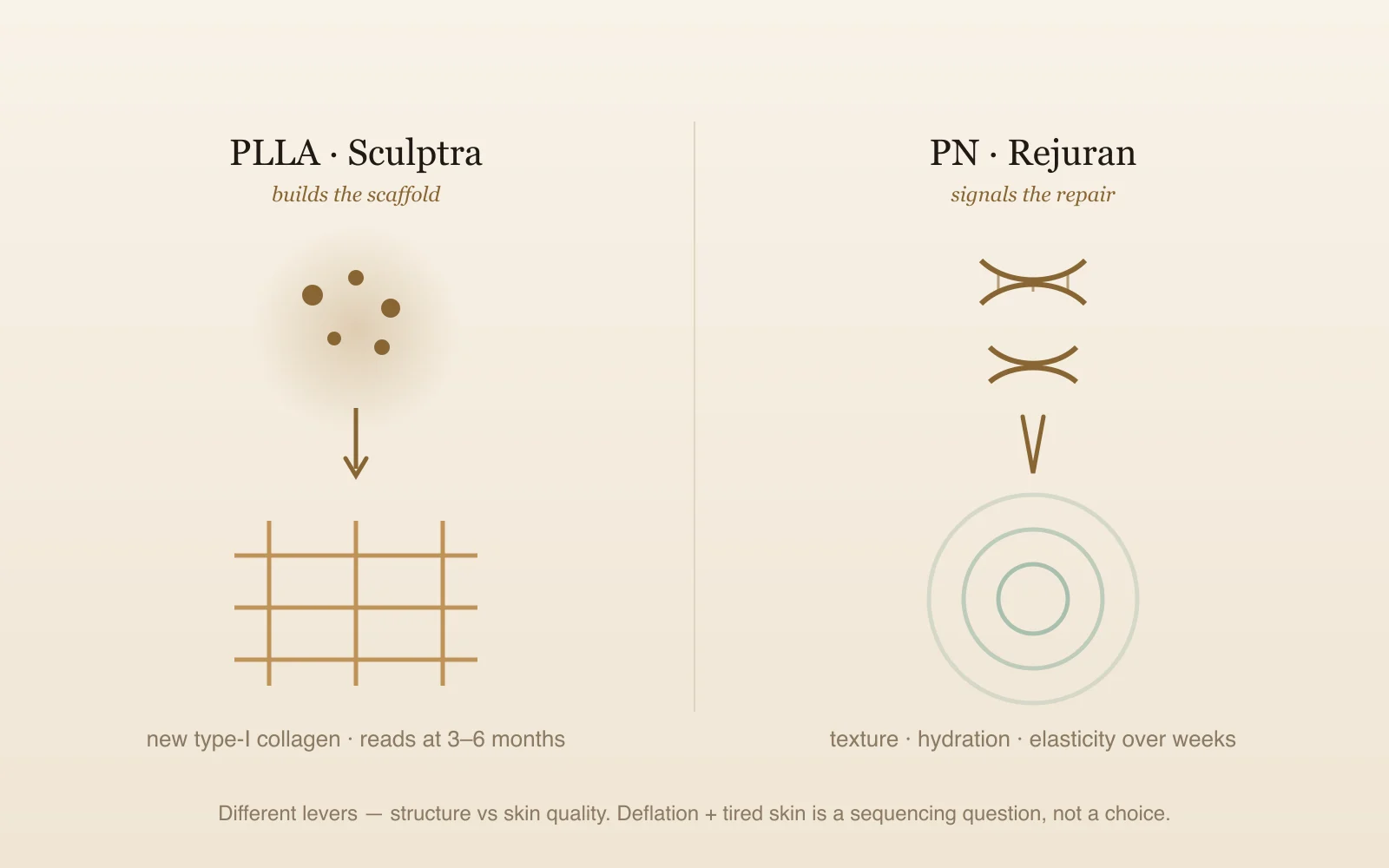
Sculptra is poly-L-lactic acid (PLLA), a biostimulator. Injected microparticles trigger a controlled foreign-body response that recruits fibroblasts to build new type I collagen over months, while the particles themselves gradually hydrolyze away (PMID 16936544). The product acts as a stimulus for your body to build its own collagen scaffold.
Rejuran is a polynucleotide (PN), purified DNA fragments of salmon origin. Rather than volumizing, PN and its shorter-fragment sibling PDRN act as biological signals: a 2025 mechanisms review describes PN as supporting extracellular-matrix remodeling while PDRN engages adenosine A2A receptors and feeds nucleotide salvage pathways (PMID 40871045; pharmacology in PMID 28491036). The target is skin quality (texture, hydration, elasticity), not projection.
Comparing the clinical evidence for each product
The two products also differ in how much published evidence stands behind them, which is an important point of comparison.
PLLA has an extensive, decades-long evidence base. The pivotal randomized trial against human collagen documented correction still present at 25 months in the PLLA arm (PMID 20159311), and a 48-week follow-up in an early studied use (HIV-associated facial lipoatrophy) showed durable correction (PMID 19245538).
PN evidence is promising but more recent and limited. A 2024 systematic review found nine eligible studies covering 219 patients, reporting improvements in wrinkles, texture and elasticity with mostly mild, transient side effects, while grading the evidence quality as low to moderate and calling for rigorous trials (PMID 39645667). Head-to-head data exist on a small scale: in a randomized split-face trial around the eyes comparing PN with non-crosslinked hyaluronic acid, overall visual and global-improvement scores did not differ significantly, while several instrumental measures (elasticity, hydration, roughness, pore volume) favored PN, with no serious adverse events. The result applies to the PN formulation studied, not automatically to every Rejuran product (PMID 32248707). Useful signals, from studies of dozens, not thousands.
Key differences to consider
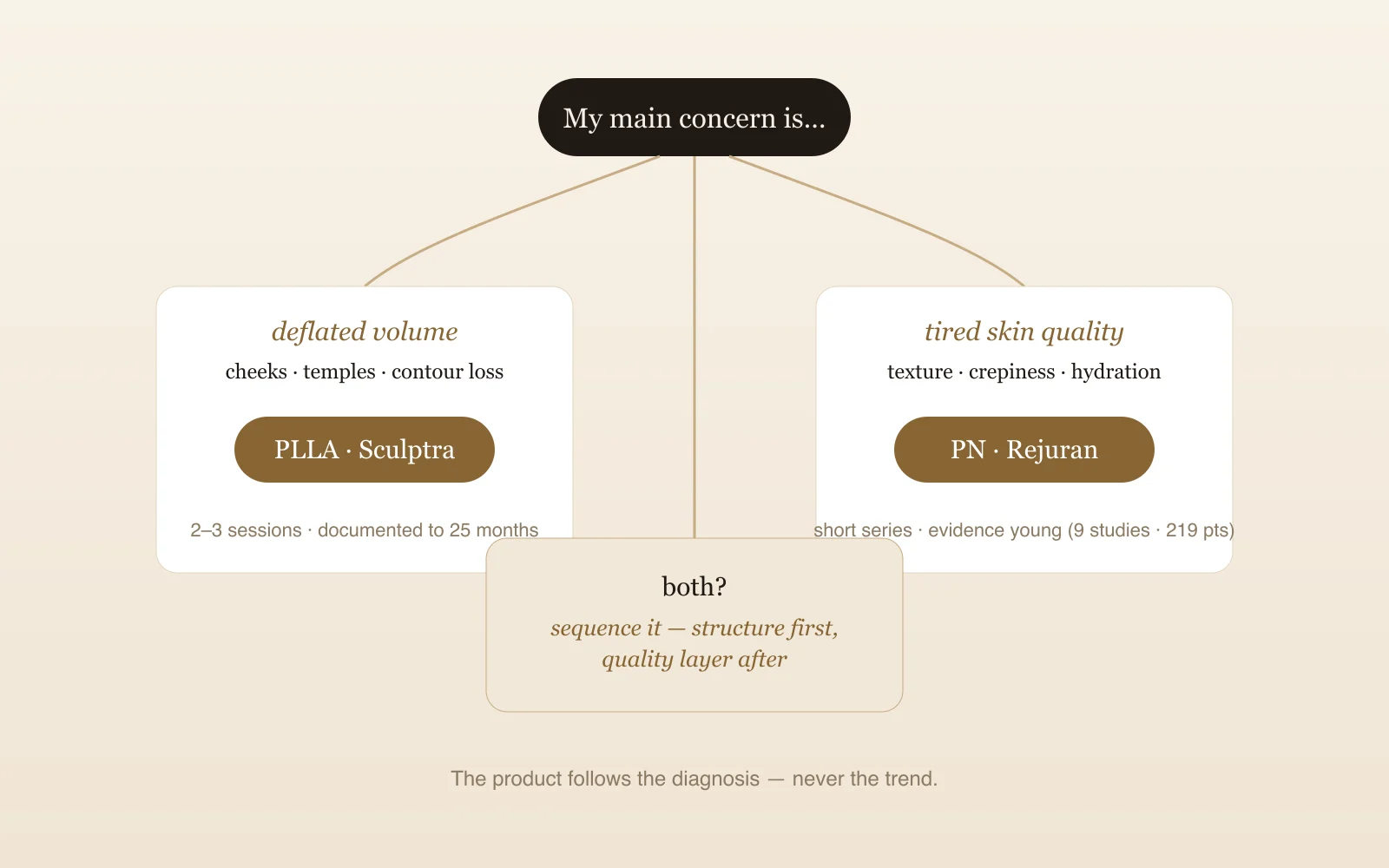
- Main question answered: Sculptra: "my cheeks and temples have deflated." Rejuran: "my skin looks tired, thin, crepey."
- Onset: Sculptra builds over 2–3 sessions and is visible at 3–6 months. PN studies used varied products and schedules; no single Rejuran course or response window is established, so plans are set per patient.
- Durability: PLLA correction has been documented out to 25 months in trial conditions (PMID 20159311); long-term PN durability has not been established at comparable evidence depth.
- Downtime: both are injectables: expect possible pinpoint marks, transient swelling or bruising rather than device-style recovery.
- Where they meet: nothing forces a choice. Treatments for a deflated face with tired skin are often sequenced (structure first, quality layer after), which is exactly how we plan GLP-1-related facial changes.
Questions worth asking at consultation
- "Is my main problem volume, quality, or both, and in which order would you treat them?"
- "Which exact product will be used, and can I see the sealed packaging?" Verifying authenticity is standard practice here, not an insult.
- "What does the evidence say for my specific goal, and where is it still thin?" A clinic comfortable with that question is a good sign.
Key takeaways
- Sculptra and Rejuran are not interchangeable: one rebuilds structural collagen, the other signals skin repair.
- PLLA has more extensive, longer-term evidence; PN evidence is positive but graded low-to-moderate quality across ~219 studied patients.
- Choose by diagnosis, not trend, and remember that a sequenced combination is also an option.
FAQ
Which one is better for under-eye areas? Sculptra is generally not injected directly under the eyes. For eye-area skin quality, PN is the commonly used option of the two. The periocular randomized data above was collected exactly there (PMID 32248707).
Can I do both in the same period? They act on different layers and timelines, so sequencing them is common. The order and spacing are set by the treatment plan, not a fixed rule.
Is Rejuran the same as PDRN? Closely related, not identical: PN consists of longer DNA fragments oriented to matrix remodeling, while PDRN's shorter fragments act mainly through receptor signaling, the distinction is drawn in the 2025 mechanisms review (PMID 40871045).
Sources
- Narins RS, et al. A randomized study of the efficacy and safety of injectable poly-L-lactic acid versus human-based collagen implant in the treatment of nasolabial fold wrinkles. J Am Acad Dermatol. 2010;62(3):448-62. PMID 20159311 · DOI
- Vleggaar D. Soft-tissue augmentation and the role of poly-L-lactic acid. Plast Reconstr Surg. 2006;118(3 Suppl):46S-54S. PMID 16936544 · DOI
- Carey DL, et al. Poly-L-lactic acid for HIV-1 facial lipoatrophy: 48-week follow-up. HIV Med. 2009;10(3):163-72. PMID 19245538 · DOI
- Kim ST. Comparison of polynucleotide and polydeoxyribonucleotide in dermatology: molecular mechanisms and clinical perspectives. Pharmaceutics. 2025;17(8):1024. PMID 40871045 · DOI
- Lampridou S, et al. The effectiveness of polynucleotides in esthetic medicine: a systematic review. J Cosmet Dermatol. 2024;24(2):e16721. PMID 39645667 · DOI
- Lee YJ, et al. Comparison of the effects of polynucleotide and hyaluronic acid fillers on periocular rejuvenation: a randomized, double-blind, split-face trial. J Dermatolog Treat. 2020;33(1):254-260. PMID 32248707 · DOI
- Squadrito F, et al. Pharmacological activity and clinical use of PDRN. Front Pharmacol. 2017;8:224. PMID 28491036 · DOI
Disclaimer: This content is general information and not medical advice. Product suitability and treatment planning require an in-person assessment by a qualified dermatologist.
Lưu ý: Thông tin trong bài chỉ mang tính giáo dục chung, không thay thế tư vấn y khoa. Kế hoạch điều trị cá nhân được xác định qua buổi tư vấn với bác sĩ da liễu chuyên khoa. Kết quả có thể khác nhau.
Liệu trình liên quan