
The September Reset: Repairing What Summer Did to Your Pigment
Melasma and sun spots look worst right after summer, and autumn's lower UV makes correction easier to plan. A September-to-December reset: why gentle beats aggressive, and where oral tranexamic acid fits.
Every September the same conversation repeats in our consultation room: "My melasma got so much darker this summer. Can we now treat it hard and fast?" Half of that sentence is right: autumn's lower UV makes it a far more forgiving season for correction, though the safe starting point for any individual face is set by tanning, barrier status and an examination, not by the calendar. The other half (hard and fast) is precisely how melasma patients end up worse in December than they were in August.
Why your pigment looks worst right now
Melasma is not a stain sitting on the skin; current evidence frames it as a photoaging disorder in genetically predisposed skin, in which ultraviolet (and even visible light) drives pigment cells embedded in an altered dermal environment (PMID 29285880). Histology studies show it sits on damaged ground: solar elastosis, a disrupted basement membrane, increased blood vessels and mast cells (PMID 27240341). A Korean summer (UV, heat, sweat, beach weekends) feeds every one of those inputs. September skin reveals the cumulative effects of this exposure.
Why "hard and fast" backfires on melasma
The "hit it hard" instinct runs into an uncomfortable piece of evidence: rebound has been documented even at low fluence. In a randomized split-face study of low-fluence Q-switched 1064 nm laser in Asian patients, the laser side improved markedly at first, then 4 of 22 patients developed rebound hyperpigmentation, and melasma recurred in all 22 participants during follow-up, alongside cases of mottled hypopigmentation (PMID 20298254). If even careful low-fluence courses demand that much respect, aggressive settings deserve more caution, not less. No study validates one clinic's exact protocol, but this is the kind of evidence behind our own deliberately conservative toning habits (low fluence, per-patient dose discipline, and a willingness to pause) and behind managing melasma as a condition rather than "removing" it like a tattoo.
What a careful reset actually looks like
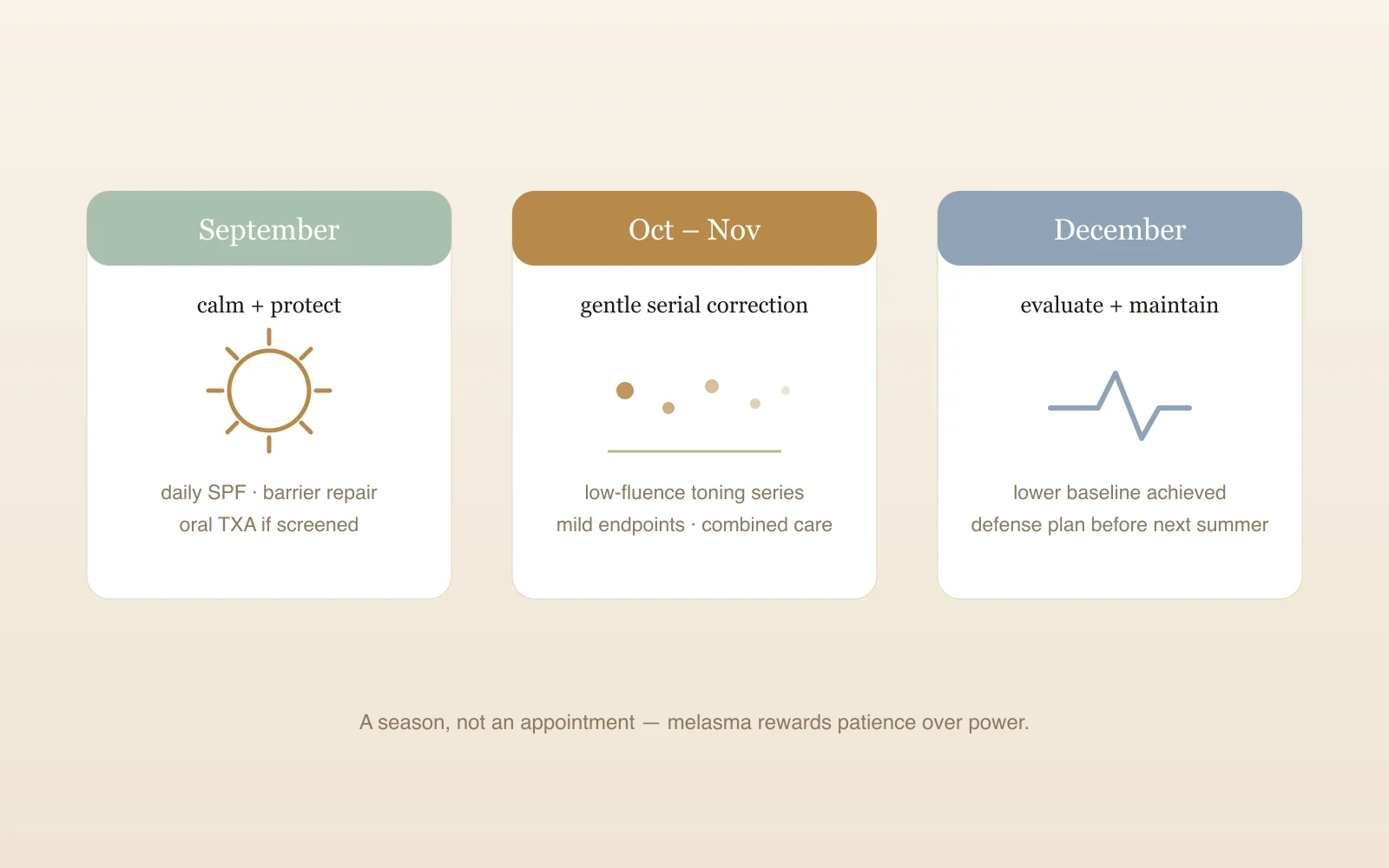
1. September: calm, protect, and start the systemic layer
The first step focuses on protection and reduction: strict daily broad-spectrum sunscreen (UV drove the damage; visible light matters too per the photoaging model above), heat and friction reduction, and barrier repair. For appropriate candidates, this is also when oral tranexamic acid enters. A 2024 meta-analysis of randomized trials found that adding oral TXA to standard triple-combination topical therapy improved MASI scores significantly more than topicals alone, and cut recurrence risk by roughly 72% (risk ratio 0.28) (PMID 38848545). Screening comes first: TXA has real contraindications, including clotting history, and it is prescribed after an individual medical review, never as a walk-in add-on.
2. October–November: gentle, serial correction
With the skin calmed and the systemic layer working, conservative energy treatment earns its place: low-fluence toning in a multi-session series, endpoints kept mild, combined care rather than laser monotherapy. Korean clinical data supports the pairing: patients receiving oral TXA alongside light and low-fluence laser treatment improved more than those receiving light and laser alone, notably during periods of higher sun exposure (PMID 22103770).
3. December: evaluate and establish a maintenance plan
By early winter the course is assessed honestly: what cleared, what softened, what needs a maintenance plan before next summer. Melasma's recurrence biology means the goal of the reset is a lower baseline plus a defense plan, not a promise of permanent erasure.

Sun spots are more straightforward to treat
Discrete solar lentigines, the sharp-edged "sun spots" that appear on cheekbones and hands after summer, behave differently from melasma and, once diagnosed, tend to respond more directly to targeted treatment; autumn's lower UV also makes aftercare easier to manage, though season alone does not determine the response. The catch is diagnostic, not procedural: flat brown spots that appeared or changed this summer deserve a dermatologist's eye before any laser touches them, because lentigo look-alikes include lesions that should never be lasered. That triage is exactly what the consultation is for.
Key takeaways
- September pigment reflects summer sun damage, and autumn is the ideal season to address it.
- Aggressive laser courses on melasma have documented rebound and recurrence; gentle, serial, combined care is the evidence-backed route.
- Oral TXA, for screened candidates, adds meaningful benefit, including a ~72% lower recurrence risk in the 2024 meta-analysis.
- Think September–December program, with a maintenance floor before next summer, not a single-visit fix.
FAQ
How soon after summer can I start laser toning? Once active tanning has settled and your skin is calm. Treating recently sun-stressed skin too soon raises the risk of pigmentary complications. The September groundwork exists precisely to make October treatment safer.
Is oral tranexamic acid safe? For screened candidates in study conditions it was well tolerated, but it is a systemic medication with genuine contraindications, clotting history above all. It requires a medical review and is monitored, not casually dispensed.
Will my melasma be gone by December? The honest answer: meaningfully lighter is realistic; permanently erased is not a promise anyone should make. Melasma biology favors recurrence, which is why the plan ends with maintenance rather than a finish line.
I'm visiting Seoul for a few weeks this autumn. Is a reset possible? Depending on candidacy and scheduling, a single trip can cover assessment and the start of the plan: the systemic and topical foundation, sometimes a first treatment step; serial courses can be structured around return visits or coordinated with care at home. Bring your treatment history.
Sources
- Passeron T, Picardo M. Melasma, a photoaging disorder. Pigment Cell Melanoma Res. 2018;31(4):461-465. PMID 29285880 · DOI
- Kwon SH, et al. Heterogeneous pathology of melasma and its clinical implications. Int J Mol Sci. 2016;17(6):824. PMID 27240341 · DOI
- Wattanakrai P, et al. Low-fluence Q-switched Nd:YAG (1,064 nm) laser for the treatment of facial melasma in Asians. Dermatol Surg. 2010;36(1):76-87. PMID 20298254 · DOI
- Cho HH, et al. Role of oral tranexamic acid in melasma patients treated with IPL and low-fluence QS Nd:YAG laser. J Dermatolog Treat. 2011;24(4):292-6. PMID 22103770 · DOI
- Ribeiro Gonçalves O, et al. Assessing the efficacy of oral tranexamic acid as an adjuvant to triple combination topical treatment in melasma: a meta-analysis of randomized controlled trials. Clin Exp Dermatol. 2024;49(12):1518-1524. PMID 38848545 · DOI
Disclaimer: This content is general information and not medical advice. Melasma management, tranexamic acid candidacy and laser settings require individual assessment by a qualified dermatologist.
Lưu ý: Thông tin trong bài chỉ mang tính giáo dục chung, không thay thế tư vấn y khoa. Kế hoạch điều trị cá nhân được xác định qua buổi tư vấn với bác sĩ da liễu chuyên khoa. Kết quả có thể khác nhau.
Liệu trình liên quan