
Ozempic Body: Skin Tightening After GLP-1 Weight Loss in Seoul
Ozempic body: loose, crepey skin after rapid GLP-1 weight loss. How ONDA Coolwaves and hyperdilute Sculptra support body skin tightening in Seoul.
"I lost the weight, so why does my body look older?"
It is one of the most common openings we hear in consultation now. A patient has done the hard part: 15-20% of body weight gone on semaglutide (Ozempic, Wegovy) or tirzepatide (Mounjaro, Zepbound), metabolic numbers improved, clothes two sizes down. But the mirror shows something the scale never warned about: loose skin on the upper arms, a crepey lower abdomen, inner thighs that have lost their firmness, cellulite that looks more visible than before. The lay press has started calling it "Ozempic body," the less famous sibling of Ozempic face.
The pattern is now documented in the aesthetic literature. A 2025 review in the Journal of Cosmetic Dermatology on semaglutide's impact on body contouring and skin health describes exactly this triad (skin laxity, body contour irregularities, and surface-quality decline) as a predictable consequence of rapid GLP-1-induced fat loss, and calls for multimodal, personalized management rather than any single fix (Haykal et al., PMID 39645647). To be clear: the medication is doing what it was approved to do. The skin simply cannot retract as fast as the fat disappears.
Body skin is not face skin: three differences that change the plan
Most "Ozempic face" content translates poorly to the body, because body skin fails differently.
First, the surface area and stretch history are larger. Skin over the abdomen, arms, and thighs has often been expanded for years before the weight loss. Biomechanical testing in massive weight loss patients shows this skin loses elasticity and resists retraction: it behaves like over-stretched fabric, not like a balloon that re-shrinks (Choo et al., Obesity Surgery 2010, PMID 20401759).
Second, the damage is structural, not just visual. Histological studies of skin after massive weight loss document degraded, disorganized collagen and fragmented elastic fibers, which is also why even surgical contouring in this population has documented limitations (Rocha et al., Obesity Surgery 2021, PMID 33145720). Any honest treatment plan starts from the fact that the scaffold itself is compromised.
Third, GLP-1 therapy may act on the skin directly. A 2026 review in the Journal of Clinical Medicine notes that GLP-1 receptor agonists may modulate dermal homeostasis and fibroblast activity beyond the mechanical effect of deflation (Žaliukaitė & Lebbar, PMID 42074746). The practical implication is the same one we draw for the face: rebuilding collagen matters as much as tightening what is there.
An honest triage before any device is switched on
This is where a YMYL-honest clinic has to draw a line that marketing pages usually blur. Non-surgical treatment does not replace surgery for true skin redundancy. If skin hangs in folds (an apron of lower-abdominal skin, arm skin that drapes when lifted), the standard of care is surgical body contouring, and the histology literature above explains why: no energy device can excise structurally failed skin. We say this in consultation, and patients in that category are told so directly.
Where non-surgical treatment has a defensible role is the much larger middle group: mild-to-moderate laxity without redundancy (skin that is loose, crepey, and soft but still re-drapes against the body). For this group, the published toolkit is energy-based tightening plus injectable collagen biostimulation, used as supportive improvement in elasticity and contour, not a transformation, and we frame it that way deliberately.
Tool one: ONDA Coolwaves: when the problem is fat plus laxity
Many "Ozempic body" zones are not purely loose; they are a mix of residual diet-resistant fat pockets and lax overlying skin: flanks, the under-chin transition, inner thighs, upper arms. This combination is where we reach for ONDA Coolwaves (DEKA, Italy), a 2.45 GHz microwave platform that selectively targets subcutaneous fat and the fibrous septa involved in cellulite while actively cooling the skin surface.
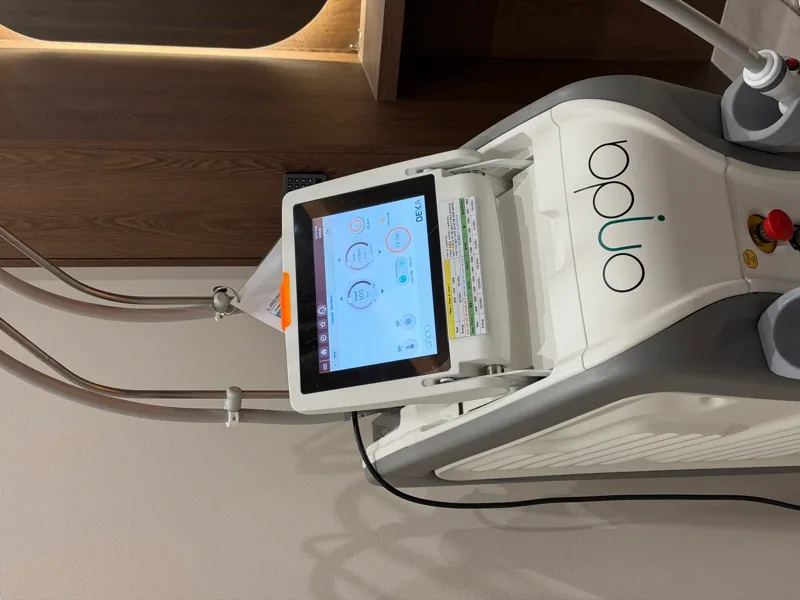
The body-contouring evidence base is specific to this device family. A clinical series using the Onda microwave system documented measurable reduction of subcutaneous adipose tissue and abdominal circumference (Bonan & Coli, Dermatologie 2023, PMID 37638988). An international advisory board consensus published in 2024 sets out patient-selection and protocol recommendations for Coolwaves treatment of cellulite and localized adiposity (Hoffmann et al., Bioengineering, PMID 39768067), and a 48-subject study documented submental fat reduction with concurrent skin-laxity improvement at 12 weeks (Salsi & Fusco, J Cosmet Dermatol 2022, PMID 35778895).
In practice: body protocols run about three sessions at 4-week intervals, 15-20 minutes per session, no anesthesia, with post-session soreness similar to a workout. Results develop over 4-8 weeks as collagen remodels. This is not a same-day result, and the device is CE-marked and MFDS-approved (not an FDA-cleared platform; we state that plainly).
Tool two: hyperdilute Sculptra off the face, rebuilding the scaffold itself
Tightening loose skin over a degraded collagen scaffold is half a plan. The other half is biostimulation, and the same logic that makes Sculptra (poly-L-lactic acid) the foundation of GLP-1 facial restoration extends, with published guidance, to the body. A 2025 international consensus in Aesthetic Plastic Surgery assessed the evidence for injectable PLLA in body aesthetic treatment (including laxity of the arms, abdomen, thighs, and buttocks) and issued practical recommendations on dilution, technique, and candidacy (Haddad et al., PMID 39592491). It builds on earlier off-face recommendations from the same group for PLLA in body skin laxity (Haddad et al., J Drugs Dermatol 2019, PMID 31524350).
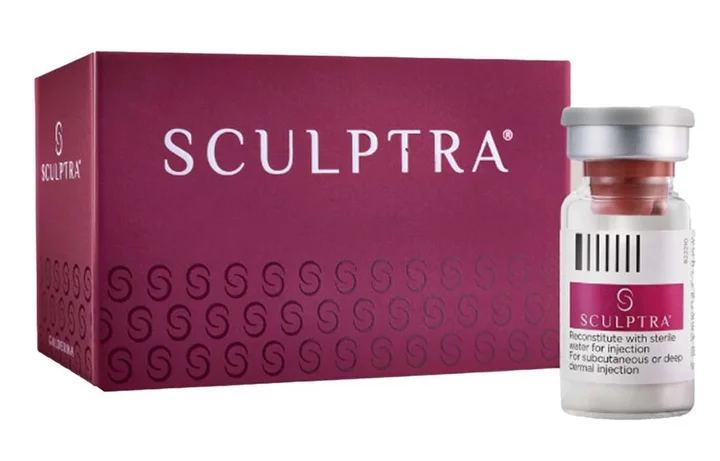
Two honest framings matter here. Sculptra's FDA approvals are facial; body treatment is consensus-guided clinical use at higher dilution (roughly 16 mL per vial for body versus 8-9 mL for face in our protocols), and we present it as exactly that. And it is slow by design: PLLA does not fill. It triggers months of gradual fibroblast-driven collagen production, with change accumulating over a staged series rather than appearing in a week. For the post-GLP-1 patient, that biology is the point: the deficit being treated is collagen.
How the pieces fit, and what a first consultation actually decides
We do not run a fixed "Ozempic body package." The consultation maps three things zone by zone: where residual fat pockets remain (ONDA's primary target), where laxity dominates without redundancy (where ONDA tightening and hyperdilute Sculptra can be layered, typically staggered across the same 8-12 week window), and where redundancy crosses into surgical territory (where we refer rather than treat). Patients already on a facial restoration plan (described in our Ozempic face guide) usually run the body plan in parallel, since session spacing for both is measured in weeks. GLP-1 medication does not need to be paused for any of this; it is disclosed and reviewed as part of standard medical screening.
Questions we hear in consultation
Will my skin tighten on its own if I just wait? Partially, and it depends on age, genetics, and how long the skin was stretched. Younger patients with shorter stretch history retract best. The histology evidence is sobering for skin stretched over many years, which is why we triage honestly rather than promise retraction.
Is this the same as CoolSculpting or other fat-freezing? No. Cryolipolysis targets fat only. The post-GLP-1 problem is usually laxity-dominant, where a fat-only device can make loose skin look looser. ONDA's microwave mechanism addresses fat and dermal tightening in the same session, which is why the consensus literature positions it differently.
How many trips does an international patient need? Body protocols are spaced at 4-week intervals, so a typical plan is two to three visits, or a first session in Seoul with documented parameters for continuation. If your travel window cannot support the spacing, we say so before you book anything.
If you are weighing options after GLP-1 weight loss, the useful first step is a zone-by-zone assessment, not a package quote. Book a consultation here; the conversation covers your anatomy, your timeline, and the published evidence, including a frank answer if surgery or simply waiting is the better recommendation for your case.
Reviewed by
ONDA Coolwaves: Regulatory status must be verified for the exact model and jurisdiction against an authoritative primary record.
Sources
- Haykal D, Hersant B, Cartier H, Meningaud JP. The Role of GLP-1 Agonists in Esthetic Medicine: Exploring the Impact of Semaglutide on Body Contouring and Skin Health. J Cosmet Dermatol. 2025 Feb. PMID 39645647
- Žaliukaitė G, Lebbar N. Effects of Glucagon-like Peptide-1 Receptor Agonists on Skin Homeostasis and Skin Aging Processes. J Clin Med. 2026 Apr. PMID 42074746
- Rocha RI, Junior WC, Modolin MLA, et al. Skin Changes Due to Massive Weight Loss: Histological Changes and the Causes of the Limited Results of Contouring Surgeries. Obes Surg. 2021 Apr. PMID 33145720
- Choo S, Marti G, Nastai M, et al. Biomechanical properties of skin in massive weight loss patients. Obes Surg. 2010 Oct. PMID 20401759
- Haddad A, Avelar L, Fabi SG, et al. Injectable Poly-L-Lactic Acid for Body Aesthetic Treatments: An International Consensus on Evidence Assessment and Practical Recommendations. Aesthetic Plast Surg. 2025 Mar. PMID 39592491
- Haddad A, Menezes A, Guarnieri C, et al. Recommendations on the Use of Injectable Poly-L-Lactic Acid for Skin Laxity in Off-Face Areas. J Drugs Dermatol. 2019 Sep. PMID 31524350
- Bonan P, Coli F. Results on reduction of subcutaneous adipose tissue using a novel body contouring system based on microwave technology. Dermatologie (Heidelb). 2023 Oct. PMID 37638988
- Hoffmann K, Zappia E, Bonan P, et al. Microwave-Energy-Based Device for the Treatment of Cellulite and Localized Adiposity: Recommendations of the "Onda Coolwaves" International Advisory Board. Bioengineering (Basel). 2024 Dec. PMID 39768067
- Salsi B, Fusco I. Non-invasive system delivering microwaves energy for unwanted fat reduction and submental skin tightening: Clinical evidence. J Cosmet Dermatol. 2022 Nov. PMID 35778895
Lưu ý: Thông tin trong bài chỉ mang tính giáo dục chung, không thay thế tư vấn y khoa. Kế hoạch điều trị cá nhân được xác định qua buổi tư vấn với bác sĩ da liễu chuyên khoa. Kết quả có thể khác nhau.
Liệu trình liên quan