
Seborrheic Dermatitis: Why It Flares as Seasons Turn
Red, flaky patches at the nose, brows and scalp that return every autumn are often seborrheic dermatitis. What drives the cycle, and what published trials actually support.
The flaking that shampoo does not fix. Redness beside the nose that gets called "sensitive skin" for years. An itchy scalp that calms down every summer and returns as the air turns cool. If that pattern sounds familiar, it may be consistent with seborrheic dermatitis (one of the most common inflammatory skin conditions dermatologists see, and one of the most persistently mislabeled), though an examination is what separates it from the conditions that imitate it. DermatologyNews’ seasonal piece, Seborrheic dermatitis: autumn flares and new treatments, covers the same seasonal pattern from the treatment side.
What seborrheic dermatitis actually is
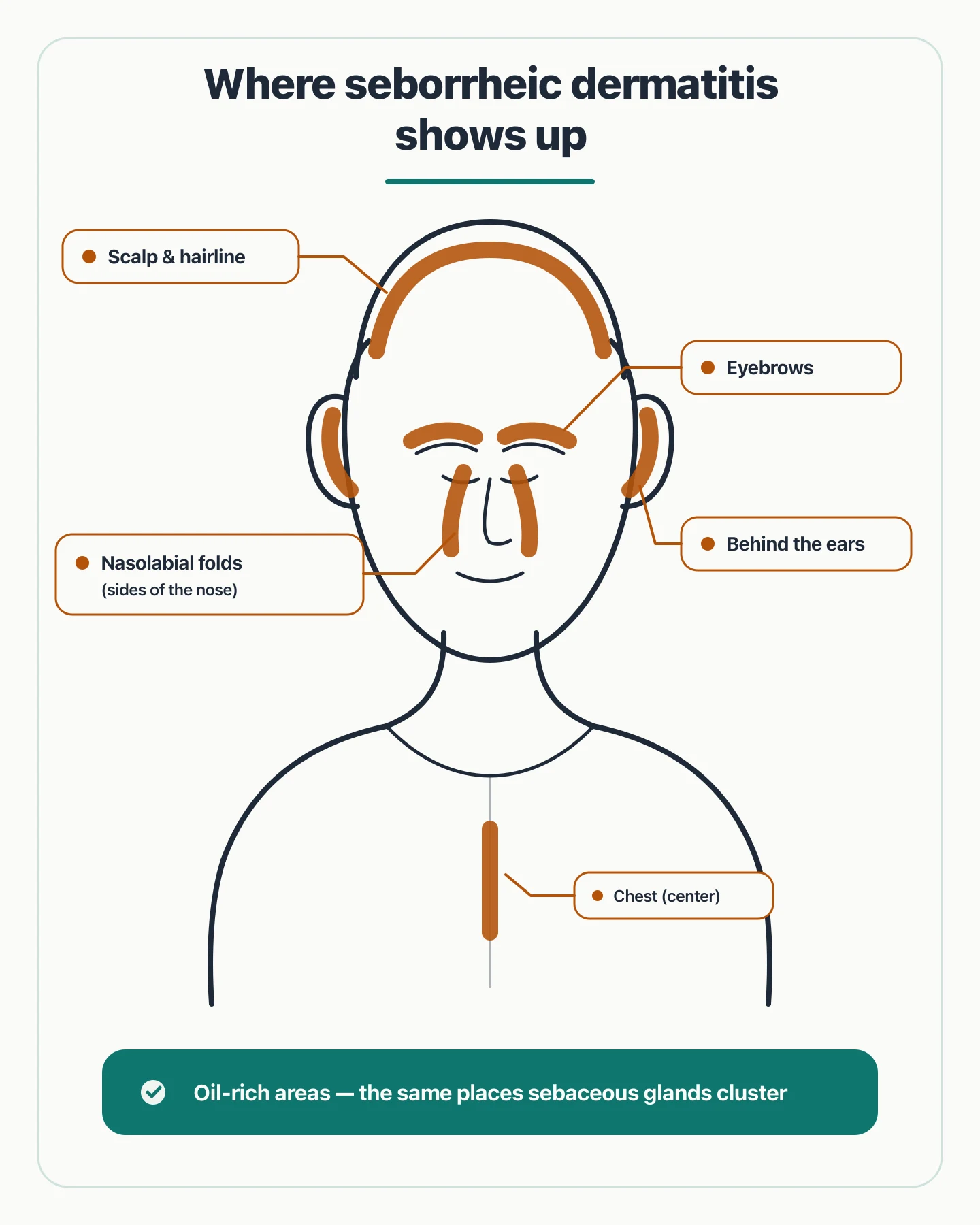
Seborrheic dermatitis is a chronic, relapsing inflammatory condition of the oil-rich areas of skin: the scalp and hairline, the eyebrows, the folds beside the nose, behind the ears, and sometimes the center of the chest. Mild scalp-only involvement without visible inflammation is what most people call dandruff, the mildest form of the condition.
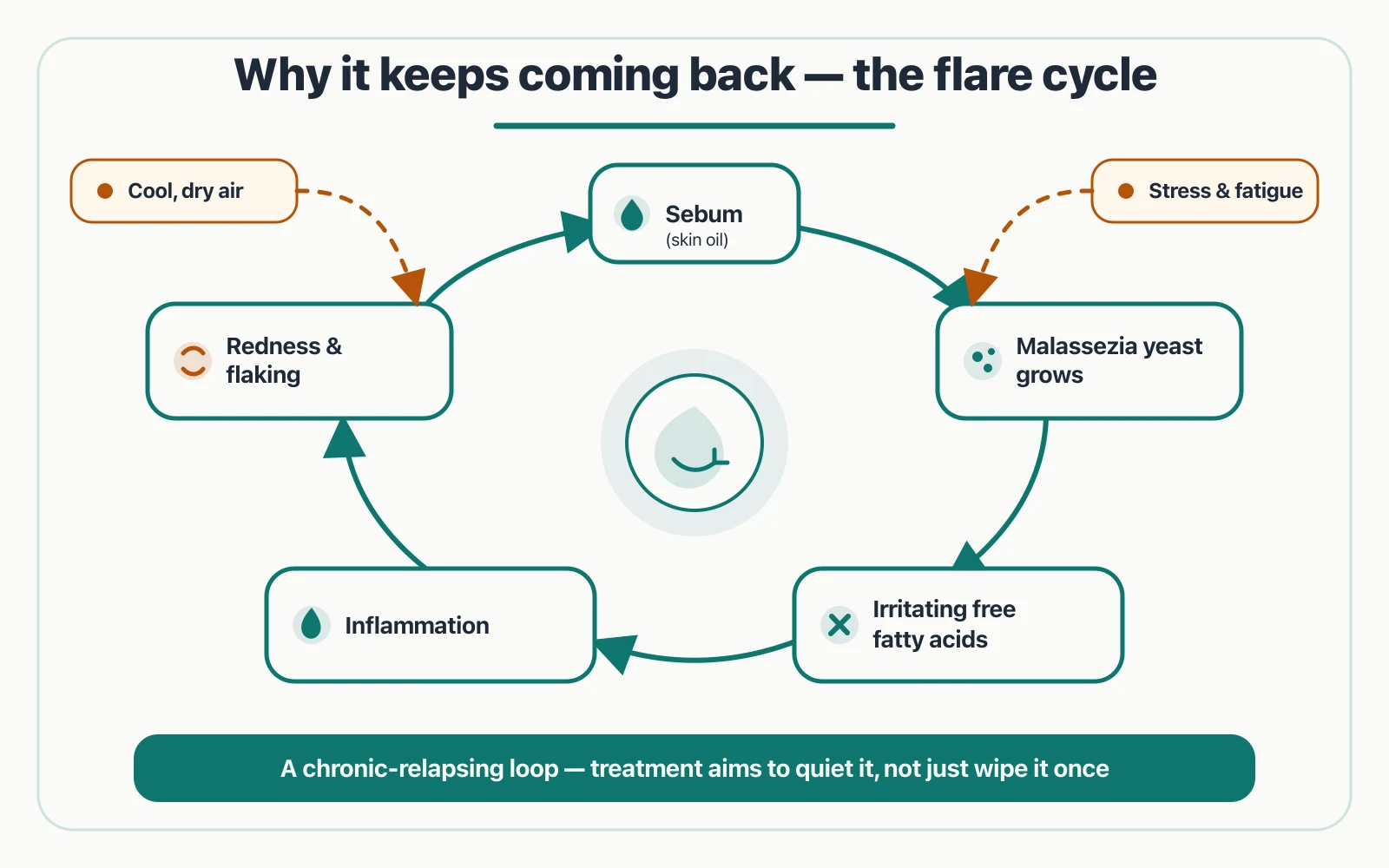
The current understanding, summarized in a 2023 review of its pathobiology, involves several interacting factors rather than a single cause: sebum production, an overgrowth of Malassezia (a yeast that lives on everyone's skin), irritating free fatty acids released when that yeast breaks down sebum, an inflammatory response, and a disrupted skin barrier (PMID 36842718). These factors are neither an infection you caught nor a hygiene failure. Scrubbing harder makes the barrier component worse, not better.
Why the calendar seems to control it
Many patients can predict their flares by the season: better through humid Korean summers, worse when autumn and winter bring cooler, drier air and indoor heating. The published literature describes seborrheic dermatitis as a relapsing condition whose activity fluctuates with environmental conditions and with stress and fatigue, a pattern most people with the condition recognize immediately. The practical implication matters more than the mechanism: if your skin follows this calendar, the weeks before your usual flare season are the time to restart maintenance care, not the middle of a flare.
What the evidence supports
Seborrheic dermatitis is one of the better-studied conditions in dermatology, and the evidence base is worth knowing before buying another product promising to "cure" flaking.
Topical antifungals are the established first line
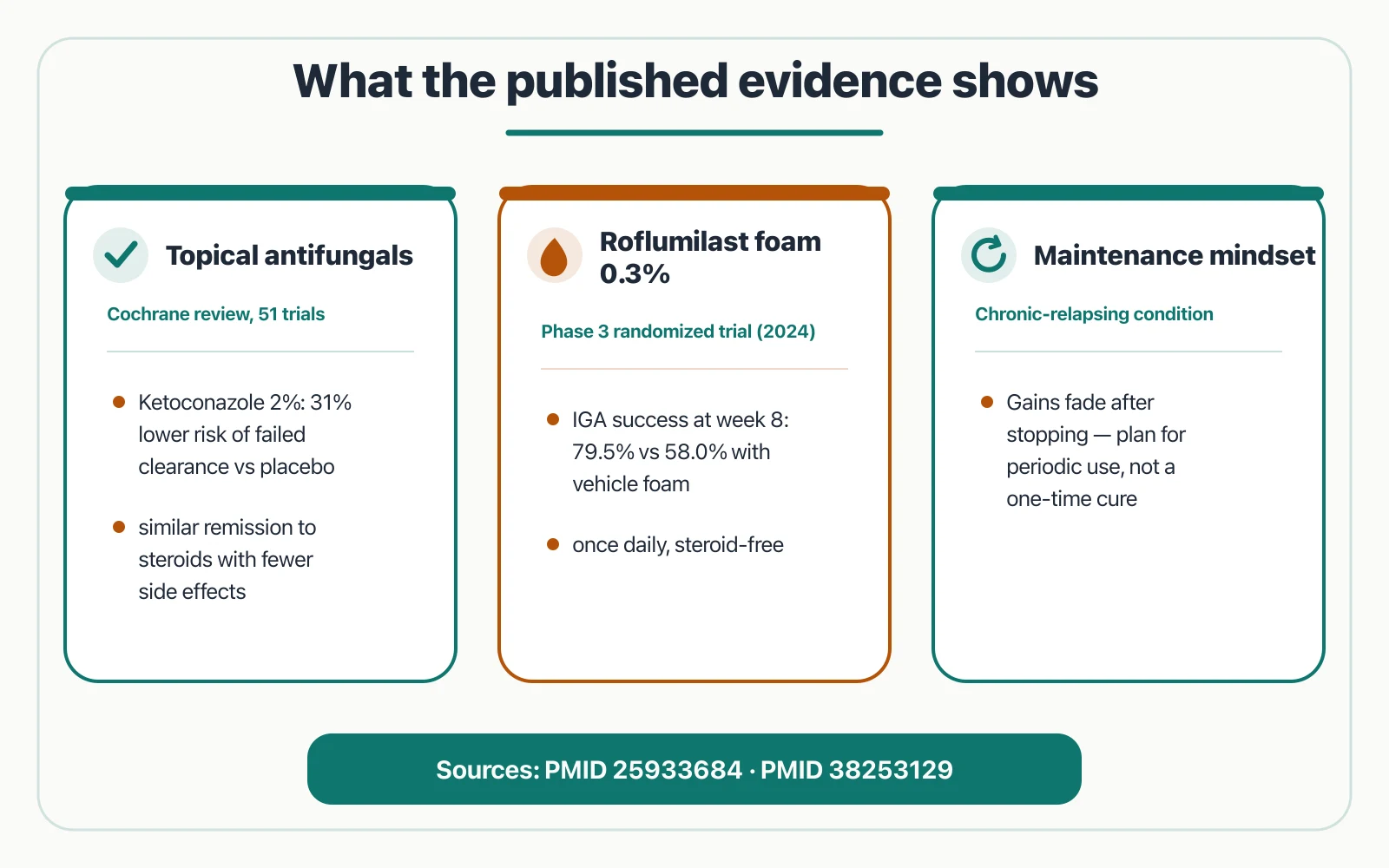
A Cochrane systematic review pooling 51 randomized trials with over 9,000 participants found that ketoconazole 2% reduced the risk of failed clearance by 31% compared with placebo, and that ciclopirox 1% also outperformed placebo. Just as importantly, ketoconazole achieved remission rates similar to topical steroids, with markedly fewer side effects (PMID 25933684). That is why an antifungal shampoo or cream, not a steroid, is usually the foundation of care: it targets the yeast side of the cycle and is safe to use repeatedly over years.
A newer non-steroidal option has phase 3 data
The most notable recent development is roflumilast foam 0.3%, a once-daily topical anti-inflammatory (a PDE4 inhibitor, not a steroid and not an antifungal). In a phase 3 randomized, vehicle-controlled trial published in 2024, 79.5% of patients using roflumilast foam reached the trial's primary endpoint (clear or almost-clear skin with meaningful improvement at week 8) versus 58.0% with the vehicle foam alone, with differences visible from week 2 (PMID 38253129). An earlier phase 2a trial published in JAMA Dermatology showed the same direction of effect, including on itch (PMID 37133856).
Two caveats apply to these results. The high vehicle response reminds us that regular gentle care alone helps many people. And the trials ran for eight weeks. For a condition that lasts years, durability beyond that is still being studied. Approval and availability also differ by country; which prescription options are currently available in Korea is a question for the dermatologist in front of you, not for a blog post.
What this means for how you treat it
- Think control, not cure. Every effective treatment studied shows the same pattern: gains fade after stopping. Planning for periodic maintenance use (for example, continuing an antifungal shampoo once or twice a week after things calm down) is more effective than a short, intense burst of treatment.
- Be gentle with the barrier. Hot water, aggressive scrubbing, and alcohol-heavy toners aggravate the barrier-disruption side of the cycle. Lukewarm water and a bland moisturizer are not exciting advice, but they are consistent with how the condition works.
- Steroids have a narrow role. Short courses can settle an angry flare, but the Cochrane data showing antifungals achieve similar remission with fewer side effects is why long-term steroid use on the face is not recommended.
- Lifestyle factors may play a role, but interpret them with caution. A 2024 systematic review found associations (not proven causes) between seborrheic dermatitis and factors like regular alcohol use and a Western dietary pattern, and lower serum zinc and vitamin D in affected patients. The authors are clear that interventional studies are still needed, so treat these as reasonable general-health nudges rather than a treatment plan (PMID 39102684).
When it is worth seeing a dermatologist
Self-care with an over-the-counter antifungal shampoo is a reasonable first step for mild scalp flaking. A clinic visit is recommended for more complex cases, because several conditions imitate each other around the center of the face:
- Persistent facial redness can be seborrheic dermatitis, rosacea, or both at once; they are managed differently. Our guide to facial flushing versus rosacea covers that boundary, and our guide to the four types of rosacea goes deeper.
- Scalp involvement plus shedding deserves a proper look. Seborrheic dermatitis does not directly cause pattern hair loss, but an inflamed scalp and hair concerns often arrive together, and the hair-loss diagnosis roadmap explains why naming the type first matters.
- Thick, sharply bordered plaques, especially with nail changes, raise the question of psoriasis, a diagnosis worth confirming before years of the wrong shampoo.
A dermatologist can usually distinguish these with an examination, confirm what you actually have, and match a prescription plan to how your skin behaves across the year, including maintenance care to prevent severe flares.
Frequently asked questions
Is seborrheic dermatitis contagious? No. Malassezia lives on virtually everyone's skin; the condition reflects how an individual's skin responds to it, not something transmitted between people.
Is it caused by being unclean? No, and over-washing tends to worsen the barrier disruption that feeds the cycle. The condition clusters where oil glands cluster, regardless of hygiene.
Is dandruff the same thing? Mild, non-inflamed scalp flaking is generally considered the mildest end of the same spectrum. When redness, itch, or facial involvement appears, it is called seborrheic dermatitis.
Can it be permanently cured? The published trials consistently show control rather than cure: treatments work while the cycle is being managed, and the condition can return when management stops. That is a reason for a sustainable routine, not for pessimism.
Which treatment should I use in Korea? Approval and availability of specific prescriptions differ by country and change over time. Bring the question to a dermatology visit: the right answer depends on where the condition appears, how severe it is, and what you have already tried.
Sources
- Okokon EO, Verbeek JH, et al. Topical antifungals for seborrhoeic dermatitis. Cochrane Database of Systematic Reviews, 2015. PMID 25933684
- Blauvelt A, Draelos ZD, Stein Gold L, et al. Roflumilast foam 0.3% for adolescent and adult patients with seborrheic dermatitis: a randomized, double-blinded, vehicle-controlled, phase 3 trial. J Am Acad Dermatol, 2024. PMID 38253129
- Zirwas MJ, Draelos ZD, et al. Efficacy of roflumilast foam, 0.3%, in patients with seborrheic dermatitis: a double-blind, vehicle-controlled phase 2a randomized clinical trial. JAMA Dermatology, 2023. PMID 37133856
- Mangion SE, Mackenzie L, Roberts MS, Holmes AM. Seborrheic dermatitis: topical therapeutics and formulation design. Eur J Pharm Biopharm, 2023. PMID 36842718
- Woolhiser E, Keime N, et al. Nutrition, obesity, and seborrheic dermatitis: systematic review. JMIR Dermatology, 2024. PMID 39102684
Medical disclaimer: This article is general education, not a diagnosis or a prescription. Whether a rash is seborrheic dermatitis (and which treatment fits) requires an individual assessment by a dermatologist.
提示: 本文信息仅供科普参考,不构成医学建议。个人治疗方案需通过皮肤科专科医生咨询确定。