Pigmentation Treatment in Seoul — Pigmentation Care

Pigmentation Care

Pigmentation Treatment in Seoul

Pico, Hollywood Spectra, and Genesis-style toning treat freckles, PIH, and melasma on Asian skin, planned by a board-certified dermatologist.

皮肤科专科医生

Board-Certified

AAD 国际院士

IFAAD

FDA 认证设备

适用项目

MFDS 注册

韩国保健福祉部

尹尚烈院长
尹尚烈院长 审校
皮肤科专科医生 · 院长 · AAD会员
01

概述

Pigmentation and melasma treatment in Gangnam — Pico, Hollywood Spectra, and Genesis toning tuned for Asian skin (Fitzpatrick III–IV).

适用于以下困扰

  • melasma
  • solar lentigines
  • freckles
  • post-inflammatory hyperpigmentation (PIH)
  • ABNOM (acquired bilateral nevus of Ota-like macules)
  • uneven tone and accumulated sun damage

推荐人群

  • patients wanting a non-aggressive, conservative pigmentation plan
  • Asian skin (Fitzpatrick III–IV) where rebound risk is high
  • patients with prior failed laser treatment or PIH history
  • international travellers needing planning around 1-week recovery on CO2-treated lesions
Pigmentation treatment — session summary
ItemDetails
Treatment time5-40 minutes depending on the device combination
SessionsDiscrete lentigines: often 1-2 PicoPlus sessions; melasma: 5-10 toning sessions at 2-4 week intervals
Pain & comfortTopical anesthesia not required for PicoPlus spot treatment, Spectra toning, or GentleMax Pro toning
DowntimeMinimal for pico / Spectra — most patients socialise the same evening; ~1 week of crusting if a CO2 portion is used
Onset of resultsLentigines microcrust and flake over days 1-3, then lighten over weeks 1-2; melasma needs multiple sessions, with peak clearance at months 2-3
Duration & maintenancePeak result 8-12 weeks after course completion; maintenance toning every 4-8 weeks for melasma-prone skin
PicoPlus vs Hollywood Spectra vs GentleMax Pro toning at a glance
CategoryPicoPlusHollywood SpectraGentleMax Pro (toning mode)
MechanismPicosecond photomechanical shockwave fractures melanin with minimal heatQ-switched Nd:YAG — low-fluence 1064 nm toning plus Carbon Peel exfoliationLong-pulsed 1064 nm gently heats the upper dermis (~40-45°C); does not fragment melanin
Best suited forFreckles, lentigines, resistant pigment; Asian-skin-safe melasma toningDiffuse melasma toning with same-visit Carbon Peel brighteningBackground redness and tone uniformity; 755 nm mode for superficial lentigines
Session time10-15 min (face spots)5-10 min (toning + carbon peel)5-10 min
Typical schedule5-10 sessions at 2-4 week intervals for melasma protocolsCombined with PicoPlus in the same visit when appropriateRepeated at 1-2 week intervals

Does laser pigmentation treatment hurt?

Most sessions are comfortable enough that topical anesthesia is not required — for PicoPlus spot treatment, Spectra toning with Carbon Peel, and GentleMax Pro toning alike. Expect mild erythema afterward, with possible faint frosting on treated lentigines that resolves within hours of the session.

What is the downtime after pico or Spectra toning?

Minimal — most patients socialise the same evening. Treated lentigines may darken briefly and form a microcrust that flakes off over days 1-3, while melasma areas usually show no immediate change. Only when fractional CO2 is added for raised lesions should you plan around one week of pinpoint crusting.

Can I fly home right after a pigmentation session?

Yes, for pico and Spectra sessions — Carbon Peel can even be added the same day before a flight without restriction. If CO2 is part of the plan for raised lesions, schedule one week before any major event or the flight home. Melasma protocols require a 2-3 month commitment.

Is pigment removal permanent?

It depends on the lesion. Discrete lentigines often clear after 1-2 PicoPlus sessions, and CO2-removed lesions are effectively permanent — though new spots can form with future sun exposure. Melasma is a managed condition: maintenance toning every 4-8 weeks plus daily broad-spectrum SPF 50+ keeps clearance stable.

治疗时长

5–40 min (varies by device)

建议次数

5–10 across 2–4 week intervals (melasma)

恢复期

Minimal for pico/Spectra; ~1 week if CO2 portion used

峰值效果

8–12 weeks after course completion

02

效果进展

  1. Immediately post

    Mild erythema; possible faint frosting on treated lentigines that resolves within hours.

  2. Day 1–3

    Lentigines may darken briefly and form a microcrust before flaking off; melasma areas usually show no immediate change.

  3. Week 1–2

    Gradual lightening of treated lentigines; melasma typically requires multiple sessions before visible change.

  4. Month 1

    Tone evens; texture begins to improve via the Genesis-style toning effect.

  5. Month 2–3

    Peak clearance; the maintenance phase begins.

  6. Month 6–12

    Maintenance toning every 4–8 weeks recommended for melasma-prone skin.

03

使用设备

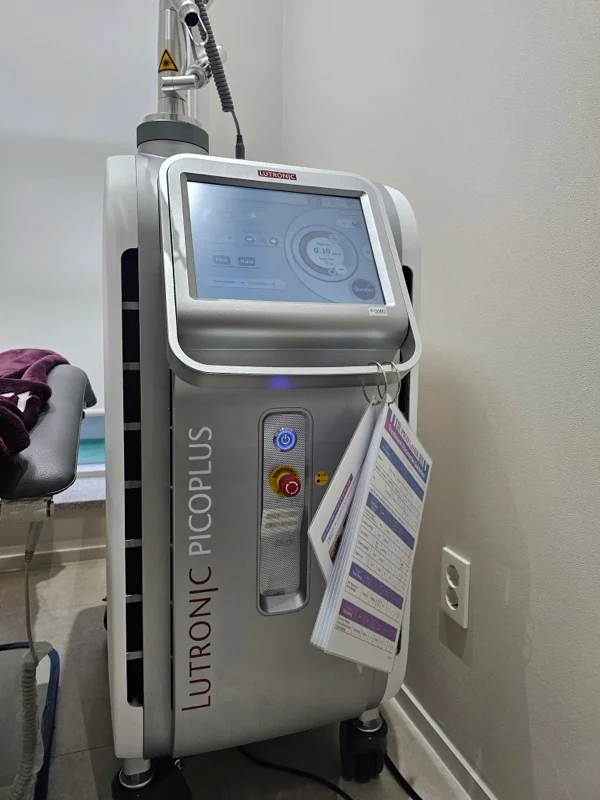
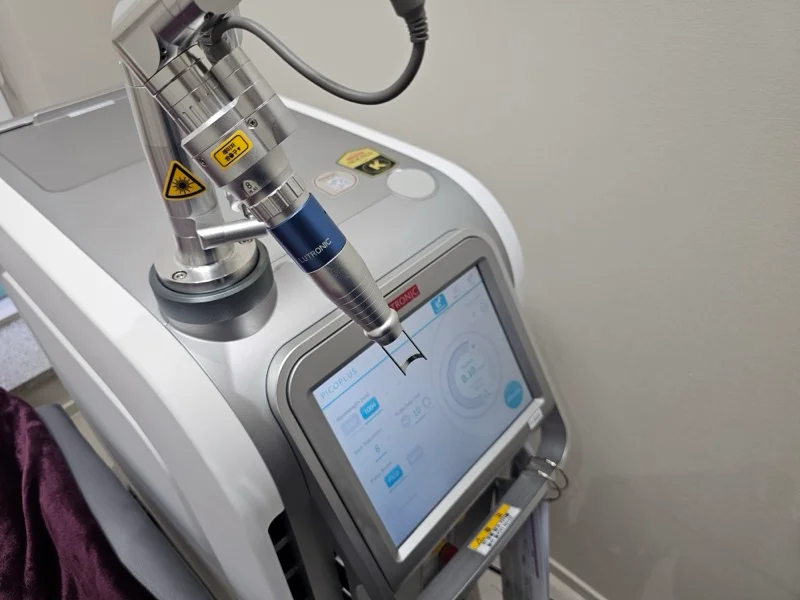
Lutronic PicoPlus picosecond laser system

PicoPlus

LutronicFDA 510(k) cleared picosecond laser; multiple clearances for benign pigmented lesions and tattoo removal

关键规格

Picosecond pulse duration (~450 ps) — shorter than the thermal relaxation time of melanosomes
Energy converts primarily into a photomechanical (photoacoustic) shockwave rather than heat
Shockwave fractures melanin into sub-micron particles cleared by macrophages, with significantly less collateral thermal injury than nanosecond Q-switched lasers
Thermal-sparing profile makes it preferred for darker (Fitzpatrick III–V) skin where PIH risk is elevated
Wavelengths used at Delight
532 nm (superficial pigment — freckles, lentigines), 1064 nm (Asian-skin-safe melasma toning + dermal pigment), 660 nm and 595 nm available for tattoo and ABNOM
Typical session
10–15 min for face spots; 20–30 min for tattoo work
Topical anesthesia not required for spot treatment
Repeat
5–10 sessions for melasma protocols at 2–4 week intervals

Hollywood Spectra (Spectra XT)

LutronicFDA 510(k) cleared Q-switched Nd:YAG laser system

关键规格

Wavelengths
1064 nm and 532 nm Q-switched Nd:YAG, nanosecond pulses (~5–10 ns)
Laser Toning — low-fluence 1064 nm pulses delivered in multiple passes (sub-photothermolysis dose); selectively absorbed by melanosomes, gradually fragments melanin without ablating epidermis. Cornerstone of Asian-skin-safe melasma care.
Carbon Peel ('Hollywood Peel') — thin carbon lotion applied to skin, absorbed into pores; 1064 nm Q-switched pulse selectively absorbed by carbon particles for controlled photoacoustic exfoliation, follicular debris and sebum clearance, immediate brightening. No downtime, immediately social.
Typical session
5–10 minutes for combined toning + carbon peel
No topical anesthesia required
Candela GentleMax Pro dual-wavelength laser system

GentleMax Pro (Genesis-style 1064 nm long-pulsed Nd:YAG mode)

CandelaFDA 510(k) cleared 755 nm Alexandrite + 1064 nm long-pulsed Nd:YAG dual-wavelength platform

关键规格

Toning mode
Genesis-style 1064 nm long-pulsed Nd:YAG, sub-purpuric protocol
Mechanism — non-ablative; gently heats the upper dermis to ~40–45°C in micro-pulses across multiple passes
Controlled mild hyperthermia stimulates fibroblast activity and new collagen synthesis, reduces dilated capillaries and diffuse erythema, and refines pore appearance and tone uniformity
Does not directly fragment melanin; instead conditions the dermal canvas so pigment treatments deliver visibly cleaner results
755 nm Alexandrite mode targets superficial lentigines as a complementary treatment when surface pigment dominates
Typical session
5–10 minutes
No topical anesthesia required
Repeat
1–2 week intervals
Fractional CO2 laser system

CO2 fractional laser

FDA 510(k) cleared fractional ablative CO2 (10,600 nm)

关键规格

10,600 nm ablative wavelength absorbed by tissue water
Reserved for raised seborrheic keratoses and stubborn lentigines that pico cannot fully clear
Typical session
10–20 minutes
Recovery
~1 week (pinpoint crusting and erythema)
Result effectively permanent for treated lesions, though new lesions can form with future sun exposure
Strict broad-spectrum SPF 50+ post-treatment is non-negotiable
04

治疗流程

  1. 01

    Pigment type, depth, and rebound risk reviewed first — Wood's lamp, dermoscopy, and high-resolution photo analysis classify the pigment before any laser is selected.

  2. 02

    The dermatologist evaluates whether PicoPlus, Spectra, GentleMax Pro 1064-LP, CO2, or a combination fits the diagnosis. Test spots may be performed for ABNOM, dermal melasma, or rebound-history patients.

  3. 03

    Treatment settings (fluence, spot size, passes) and aftercare are explained before the session.

  4. 04

    A long-term maintenance plan is discussed; rebound-prone patients (melasma, ABNOM) receive a written home protocol with sun-protection and topical regimen.

注射剂与能量设备由医生亲自施行,绝不委托给护士或技师。本院的诊疗由皮肤科专科医生主导。

尹尚烈院长 · 诊疗院长 · 皮肤科专科医生 · AAD International Fellow
05

治疗前后

治疗前
治疗后
色素激光治疗
🔒 患者照片仅在事先获得书面同意的情况下公开。默认匿名处理,您可随时撤回同意。

展示案例为 Fitzpatrick III-IV (东亚人皮肤) 。较浅 (I-II) 或较深 (V-VI) 肤色的结果可能不同,咨询时会详细说明。

06

术后护理

  1. First 24 hours

    Mild redness possible. No exfoliants, no retinoids, no hot showers. Gentle cleanser only.

  2. Week 1

    Avoid AHA/BHA, retinol, and physical scrubs. Strict broad-spectrum SPF 50+ reapplied every 2–3 hours (non-negotiable for melasma patients).

  3. Week 2–4

    Resume actives gradually. Pigment-supportive topicals (tranexamic acid, niacinamide, vitamin C) reintroduced under dermatologist guidance.

  4. Long-term maintenance

    Toning every 4–8 weeks for melasma-prone skin; oral tranexamic acid or glutathione considered case-by-case under dermatologist supervision.

07

常见问题

Is PicoPlus safe for Asian / Korean skin?

Yes. The picosecond pulse duration is shorter than the thermal relaxation time of melanosomes, so energy converts primarily into a photomechanical shockwave rather than heat. This thermal-sparing profile reduces post-inflammatory hyperpigmentation risk in Fitzpatrick III–V skin compared with older nanosecond Q-switched lasers, and is the reason pico is preferred for darker phototypes.

How is Hollywood Spectra different from a regular toning laser?

Spectra is a Q-switched Nd:YAG platform that supports two distinct treatments — low-fluence 1064 nm laser toning for melasma, and the Hollywood Carbon Peel using carbon-lotion-mediated photoacoustic exfoliation. The combination of these two on the same platform, performed in the same visit, is what produces the brightening Spectra is known for.

Will the GentleMax Pro 1064 long-pulsed mode remove my freckles?

Not directly. Genesis-style 1064 long-pulsed toning improves the dermal canvas and reduces background redness — it does not fragment melanin like pico does. For freckles and lentigines, PicoPlus 532 nm or the GentleMax Pro 755 nm Alexandrite mode is the right tool. The dermatologist combines these based on what your skin actually needs.

How many sessions until I see a difference?

Discrete lentigines often clear after 1–2 PicoPlus sessions. Melasma is a chronic condition requiring 5–10 toning sessions at 2–4 week intervals before peak clearance, with maintenance every 4–8 weeks afterwards. Single-session miracles are not realistic for melasma — that framing leads to over-aggressive treatment and rebound.

Can melasma come back after treatment?

Yes. Melasma is a managed condition, not a cure. Sun exposure, hormones, and inflammation can all trigger return even after good clearance. The standard rebound-prevention plan combines maintenance toning every 4–8 weeks, daily broad-spectrum SPF 50+, and pigment-supportive topicals (tranexamic acid, niacinamide, vitamin C) under dermatologist supervision.

Can I do PicoPlus and Spectra toning during one visit?

Yes — this is a common combination at Delight. PicoPlus addresses discrete pigmented lesions while Spectra handles diffuse melasma with low-fluence toning, and Carbon Peel can be added before a same-day flight or social event. The dermatologist plans the order and energy levels so the two treatments do not compound irritation.

注意 · 禁忌

如有以下情况,请于诊察时告知医师。可能无法进行治疗或需调整方案。

  • 治疗前的咨询中会详细告知禁忌事项。

就诊须知

  • Pico-only sessions (PicoPlus + Spectra) leave minimal visible recovery — most patients socialise the same evening.
  • If CO2 is part of the plan for raised lesions, plan 1 week before any major event or flight home.
  • Carbon Peel can be added the same day before a flight without restriction.
  • Melasma protocols require a 2–3 month commitment; not suited to short-stay-only patients.
08

参考文献

本页所载的医学信息(设备规格、效果进展、安全性等)均依据下列一手资料撰写。各项陈述均对应参考相应文献。6 refs
  1. [1]A Systematic Review of Picosecond Laser in Dermatology: Evidence and Recommendations. Lasers Surg Med (Wu DC et al.) (2021).
  2. [2]Treatment of pigmentary disorders in patients with skin of color with a novel 755 nm picosecond, Q-switched ruby, and Q-switched Nd:YAG nanosecond lasers: A retrospective photographic review. Lasers Surg Med (Levin MK, Ng E, Bae YS, Brauer JA, Geronemus RG) (2016).
  3. [3]Melasma treatment in Korean women using a 1064-nm Q-switched Nd:YAG laser with low pulse energy. Clin Exp Dermatol (Cho SB et al.) (2009).
  4. [4]Low-fluence Q-switched neodymium-doped yttrium aluminum garnet (1,064 nm) laser for the treatment of facial melasma in Asians. Dermatol Surg (Wattanakrai P et al.) (2010).
  5. [5]Nonablative facial remodeling: erythema reduction and histologic evidence of new collagen formation using a 300-microsecond 1064-nm Nd:YAG laser. Arch Dermatol (Schmults CD, Phelps R, Goldberg DJ) (2004).
  6. [6]Oral Tranexamic Acid for the Treatment of Melasma: A Review. Dermatol Surg (Bala HR et al.) (2018).
医学审校Dr. SangYoul Yun· Board-Certified Dermatologist · AAD International Fellow (IFAAD) · ASLMS Member· 最近审校日期 2026-06-12

相关治疗

提示: 根据皮肤状况、治疗史和恢复因素,个体差异可能存在。所有治疗方案均通过皮肤科专科医生咨询确定。本页信息仅供参考,不构成医学建议或保证特定效果。

下一步

在决定是否做 Pigmentation Care 之前,也可以先发一条简短咨询。

先确认是否适合、时间上是否可行,以及应先看哪种治疗,通常就能让后续沟通顺畅很多。

首尔江南

在江南为本地与海外患者提供更清晰的皮肤科咨询与治疗说明。

Delight 皮肤科重视医生主导的判断、清楚的说明,以及按个人情况安排的治疗计划。

路线视频

论岘站 4号出口
新论岘站 2号出口
诊所信息

딜라이트피부과의원

4F, Building B, 509 Gangnam-daero

Seocho-gu, Seoul, South Korea

大楼内可停车。

02-517-9991

周一 - 周五 10:00 - 20:00

午休 13:00 - 14:00

周六 10:00 - 16:00

周日及韩国法定节假日休诊

位置

江南区 · 瑞草区,首尔

机构名称: 딜라이트피부과의원代表人: 윤상열电话 02-517-9991营业执照号: 357-15-02460隐私政策使用条款
外国患者诊疗注册机构
韩国保健福祉部注册 外国患者诊疗机构 (注册号 M-2024-01-08-8248)

本网站医疗信息仅供参考,不替代医学建议。个体差异可能存在。诊断和治疗方案请咨询皮肤科专科医生。