
RF Microneedling: How Far Does the Evidence Go?
Radiofrequency microneedling has real evidence for atrophic acne scars and mild laxity (comparable to fractional lasers) with a favorable safety profile. The limits, explained.
The short answer first
Radiofrequency (RF) microneedling delivers RF energy through fine needles into the dermis. The honest, evidence-based summary: it has credible evidence for atrophic acne scars (with efficacy reported as comparable to fractional lasers) and for mild-to-moderate skin laxity and texture. Its safety profile is favorable, with mostly transient redness, swelling, and short-lived discomfort. The main limitation is not whether it works, but that device settings and reporting across studies are inconsistent, and long-term and head-to-head comparison data are still limited. As always, results vary by individual.
Where the evidence is strongest: atrophic acne scars
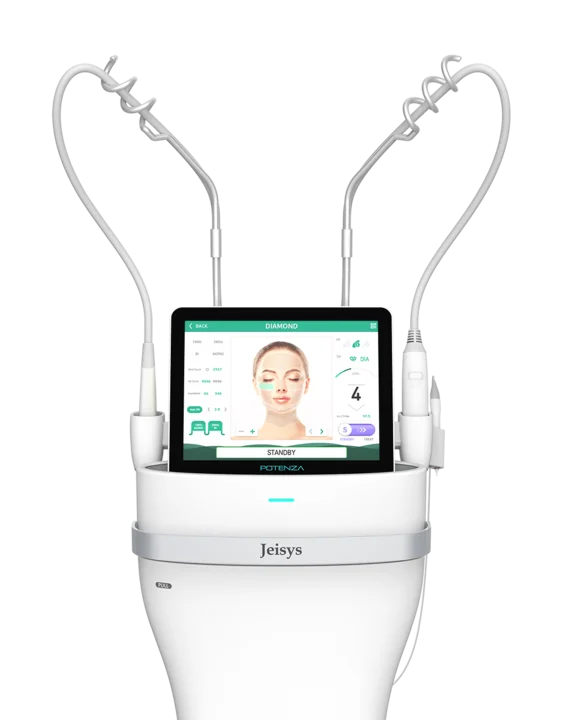
A 2026 systematic review in Aesthetic Plastic Surgery evaluated RF microneedling across dermatological conditions, including 41 studies (15 of them randomized controlled trials). For atrophic acne scars, it found that RF microneedling consistently reduced scar scores and demonstrated efficacy comparable to fractional lasers. For skin laxity and photoaging, it reported improvements in wrinkle scales, dermal density, and submental volume, some of which are supported by histological evidence (Kumar et al., 2026, PMID 42047762, DOI).
The mechanism behind skin tightening is well described in a 2025 systematic review in Health Science Reports: RF delivers targeted thermal energy to the dermis, inducing collagen contraction and stimulating neocollagenesis, with microneedle-based (multipolar) systems combining mechanical injury and thermal remodeling while sparing the epidermis (Zhang et al., 2025, PMID 41467235, DOI).
Controlled-trial evidence for laxity
Beyond reviews, there is randomized evidence. A 2023 randomized study in Plastic and Reconstructive Surgery used a split-face design and showed that microneedle fractional RF improved facial skin laxity, with measurable increases in dermal thickness and no significant change in the fat layer; the study also demonstrated that the microchannels created by RF microneedling enhanced delivery of a collagen-stimulating agent (Wu et al., 2023, PMID 38051121, DOI). A 2025 double-blind, split-neck randomized trial in the Journal of Dermatological Treatment evaluated fractional microneedle RF for neck rejuvenation and reported improvements in wrinkle severity and elasticity, with greater improvement when an antioxidant serum was combined post-treatment (Kim et al., 2025, PMID 40464749, DOI).
Safety profile
Across the reviews, the safety picture is consistently favorable for appropriate candidates: the common effects are erythema (redness), edema (swelling), and transient pain, which typically resolve quickly. Post-inflammatory hyperpigmentation was reported as infrequent and self-limited in the 2026 systematic review, and patient-reported outcomes indicated high satisfaction with minimal downtime, though that depends on appropriate settings and an experienced operator (Kumar et al., 2026, PMID 42047762).
Limits and honest unknowns
- Reporting of technical parameters (temperature, pulse width, cooling) is inconsistent across studies, which makes protocols hard to standardize and devices hard to compare directly.
- Long-term and head-to-head data remain limited; much of the evidence is short-to-medium term.
- Effect sizes vary by indication: strong for atrophic acne scars, more variable for rosacea, melasma, and striae.
- Outcomes depend heavily on operator technique and device settings, not just the device category.
How a careful plan is built
Because the right needle depth and energy depend on the indication and skin type, the plan starts with diagnosis: scar type (ice-pick, boxcar, rolling) and the realistic target for each, or the degree and distribution of laxity. For darker skin types, conservative settings and PIH-risk awareness matter more. RF microneedling is often combined with other modalities (for example, subcision for tethered scars, or a collagen-stimulating agent for laxity), and the number of sessions is tailored to the indication rather than sold as a fixed package. We are direct about which goals it suits well and which it does not.
Key takeaways
- RF microneedling has credible evidence for atrophic acne scars, comparable to fractional lasers in reviews.
- For mild-to-moderate laxity and texture, RCTs show measurable dermal improvement.
- Safety is favorable: mostly transient redness, swelling, and short-lived discomfort.
- The real limitation is inconsistent device-setting reporting and limited long-term/comparative data; operator skill matters.
FAQ
Is RF microneedling better than a fractional laser for acne scars? Reviews report comparable efficacy for atrophic acne scars; they work through different energy types (needle-delivered RF vs light). Many practitioners combine approaches. The right choice depends on scar type, skin type, and downtime tolerance, a consultation question, not a one-size-fits-all answer.
How many sessions will I need? It depends on the indication and severity; acne-scar courses typically run several sessions spaced weeks apart, with gradual improvement as collagen remodels. We base the number of sessions on the diagnosis rather than offering a fixed package.
Is it safe for darker skin tones? RF microneedling is generally considered relatively favorable across skin types because it largely spares the epidermis, but conservative settings and awareness of post-inflammatory hyperpigmentation risk remain important. An individualized assessment is essential.
Reviewed by
Reviewed by Dr. SangYoul Yun: Board-Certified Dermatologist, AAD International Fellow (IFAAD). Last reviewed: 2026-05-30. Citations are anchored in PubMed and verified at publication. This article describes both the evidence and its current limits.
Sources
- Kumar N et al. Effectiveness of Radiofrequency Microneedling in the Treatment of Dermatological Conditions: A Systematic Review. Aesthetic Plast Surg. 2026. PMID 42047762 · DOI
- Zhang B et al. The Landscape of Radiofrequency Technology for Skin Rejuvenation. Health Sci Rep. 2025;9(1):e71575. PMID 41467235 · DOI
- Wu X et al. Microneedling Radiofrequency Enhances PLLA Penetration and Improves Facial Skin Laxity without Lipolysis (RCT). Plast Reconstr Surg. 2023;154(6):1189-1197. PMID 38051121 · DOI
- Kim J et al. Fractional microneedle radiofrequency with antioxidant serum for neck rejuvenation (double-blind RCT). J Dermatolog Treat. 2025;36(1):2504655. PMID 40464749 · DOI
Disclaimer: This content is general information and not medical advice. Consult a qualified specialist before making any treatment decision.
提示: 本文信息仅供科普参考,不构成医学建议。个人治疗方案需通过皮肤科专科医生咨询确定。