
Skin Booster at Home or Injection? What the Label Means
A home device or cream sold as a skin booster is not an injectable skin booster. How the rules sort them, what evidence covers each, and what to ask.
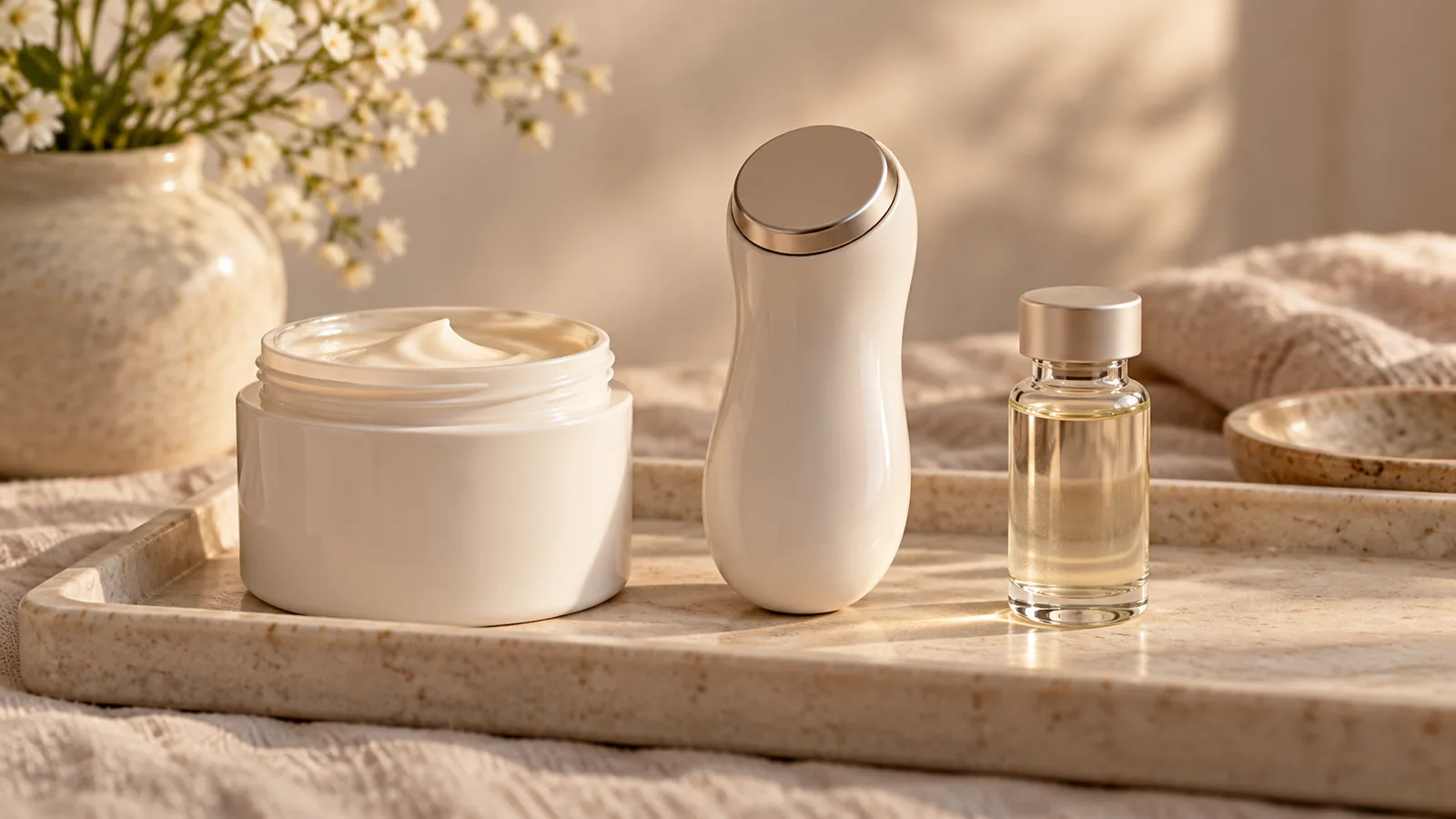
The word turns up everywhere. A serum promises to boost whatever you apply after it. A handheld device is sold as a booster for your skincare. A clinic menu lists skin boosters next to fillers. If you have seen all three in one week, it is fair to wonder whether a skin booster at home is a cheaper way to get what the injection does.
It is not the same thing. "Skin booster" is not a legal or medical category, and the word on a label does not tell you how a product works. A cream or a home device is sold to act on or through the skin's surface; an injectable skin booster is placed into the dermis by a doctor. They come under different rules, they are studied in different ways, and results published for injections do not transfer to a cream or a device that shares the name or an ingredient. Before you choose, check five things: what the product is sold as, what exactly it claims, how deep it is meant to act, what evidence exists for that product rather than its ingredient, and who should be using it.
If what is really bothering you is skin that looks flat or dull this autumn, start with what to check before buying another product for dull skin.
Three different things called a booster
Creams, serums and toners. Some skincare products carry "booster" in their name. Often it is a product meant to go on early in a routine, or one built around an ingredient people associate with injections. Either way, it is applied to the surface and rubbed in.
Home devices. Handheld devices are sold to be used alongside skincare. A 2026 review of at-home skin care devices, Layne and Weiser (2026, Facial Plast Surg, PMID: 42184823), lists the common technologies as light-emitting diode (LED) light, radiofrequency, microcurrent, low-energy laser and intense pulsed light. These devices run at lower energy than in-office equipment, and the review describes the evidence as coming from small clinical studies, with results that are generally more gradual and less pronounced than those from professional equipment. Some home products also carry very short needles.
Injectable skin boosters. In dermatology the term refers to injectables used to improve skin quality rather than to add volume. A 2024 overview, Rho et al. (2024, Arch Plast Surg, PMID: 39544509), notes that the term itself came from the name of a commercial injectable hyaluronic acid product, describes injectable boosters made from several kinds of material, hyaluronic acid and polynucleotides among them, and states that it left topical "skin boosters" out of its scope. In a survey of 235 Korean board-certified dermatologists, Rho et al. (2024, J Cosmet Dermatol, PMID: 38093498), many of those who used polynucleotide injections reported a 33-gauge needle and a serial-puncture technique aimed at the dermis, the layer that lies beneath the epidermis.
What the label tells you, and what it does not
Regulators sort products by what they are intended to do, and much of that intent is read from what the seller says about them.
In the United States, the Food and Drug Administration (FDA) explains that the law defines cosmetics by their intended use: articles applied to the body for cleansing, beautifying or changing its appearance. Drugs include articles intended to treat or prevent disease or to affect the structure or function of the body. Intended use can be established by claims on the label, in advertising and online, by consumer perception and by certain ingredients. Among the FDA's examples of claims that can make a product a drug, even when it is marketed as a cosmetic, is a claim that it will regenerate cells (FDA, Is It a Cosmetic, a Drug, or Both?). For devices, the FDA's guidance starts the same way: define the product's intended use, then check it against the legal definition of a medical device (FDA, How to Determine if Your Product is a Medical Device).
In Korea, the Cosmetics Act describes a cosmetic as a product applied, rubbed in, sprayed on or used in a similar way to clean and beautify the body, make the appearance brighter, or keep skin and hair healthy, with only a mild action on the body; products that count as medicines are excluded. Functional cosmetics are a subset that help with things such as skin brightening, wrinkle improvement or sun protection. The same law forbids labeling or advertising that could lead buyers to mistake a cosmetic for a medicine (Cosmetics Act, Articles 2 and 13). The Medical Devices Act defines a medical device as an instrument, machine, apparatus, material, software or similar product used to diagnose, treat, relieve or prevent disease, or to examine, replace or modify structure or function. It also forbids labeling or advertising a product that is not a medical device as if it had a medical device's performance or effects (Medical Devices Act, Articles 2 and 26). Both laws are administered by the Ministry of Food and Drug Safety (MFDS).
What matters is the category a product is sold under and the exact claim printed beside it. A cream that says it moisturizes or smooths the look of skin is making a cosmetic claim. If it says it regenerates, repairs or treats, ask what supports that. A device that heats, stimulates or pierces the skin should state plainly what it is sold as.
Why the same ingredient name is not the same treatment
The outermost layer of the skin, the stratum corneum, is a barrier. Bos and Meinardi (2000, Exp Dermatol, PMID: 10839713) argued that a compound generally needs a molecular weight under about 500 daltons to be absorbed through the skin, and that larger molecules cannot pass this layer. Their case rests on how known contact allergens and topical drugs behave, not on a test of any particular cream. What reaches the dermis from a jar cannot be assumed to match what a needle places there.

The injectable evidence, for its part, comes from injections. Lampridou et al. (2025, J Cosmet Dermatol, PMID: 39645667) found nine studies of polynucleotide injections involving 219 patients, rated low or moderate in quality, with varied injection areas and techniques. Several reported improvements in wrinkles, texture and elasticity, side effects were generally mild and short-lived, and the authors noted that there is still limited consensus on their optimal use. Two of the four authors disclose ties to a polynucleotide maker or its distributor; the companies were not involved in the review. In a double-blind trial, Araco and Araco (2021, Aesthet Surg J, PMID: 33755110) injected purified polynucleotide or saline in 20 women with moderate to severe acne scars; only the polynucleotide group improved significantly at one and three months, and the authors called the study preliminary. For an injectable hyaluronic acid gel placed in the skin of the cheeks, forehead and neck, Ogilvie et al. (2020, J Cosmet Dermatol, PMID: 31621189), a study with manufacturer co-authors, reported that satisfaction with skin rose from baseline in most of the 131 participants.
Ingredient names add to the confusion: polynucleotide (PN) and polydeoxyribonucleotide (PDRN) are related materials but separate evidence categories, as our skin booster page explains, so a PDRN label on a cream says even less about a PN injection.
Home devices: what to look at
Layne and Weiser describe at-home devices as built with lower energy output and safety mechanisms meant to reduce the risk of burns, pigment changes and scarring. The trade-off is a smaller and slower effect. One of the two authors reports speaking fees from aesthetic companies.
Devices with needles deserve a separate look. The FDA says some microneedling products have needles so short that they only touch the topmost layer of the skin, which is mainly dry, dead skin. Generally, if a product does not have longer or sharp needles that penetrate the skin and only claims to help exfoliation or improve the appearance of skin, the FDA would not regulate it as a medical device. The FDA also states that it has not authorized any microneedling medical device for over-the-counter sale, and it advises cleaning a home product between uses as the manufacturer directs and not sharing it with other people (FDA, Microneedling Devices).
One practice the injectable literature warns about directly is injecting a product that was made for the skin's surface. Rho et al. (2024, PMID: 39544509) write that injecting substances meant only for topical use can introduce immunogenic particles into the dermis and may lead to local or systemic hypersensitivity reactions, including foreign-body granulomas. Their advice to clinicians is to restrict skin booster use to products specifically approved for injection in humans.
Side by side
| Question | Cream or serum called a booster | Home device called a booster | Injectable skin booster |
|---|---|---|---|
| Where it is meant to act | On the surface; how much passes the stratum corneum depends on the ingredient | On or through the surface, depending on the technology | In the dermis, placed by injection |
| Who uses it | You, at home | You, at home, following the maker's instructions | A doctor, after examining your skin |
| Claims worth questioning | Regenerates, repairs, treats, works like an injection | Medical-sounding effects; needles that pierce the skin | Any promise of a fixed result, schedule or duration before an examination |
| Evidence to ask for | Studies of this product, not of its ingredient | Studies of this device as sold for home use | Studies of this product for your concern; most are small |
Five questions before you choose
- What is it sold as? A cosmetic, a functional cosmetic, a consumer appliance or a medical device. The packaging, the seller or the clinic should be able to tell you.
- What exactly does it claim? Moisturizing or improving the look of skin is a cosmetic claim. Words such as regenerate, repair or treat, or a line saying it works like an injection, deserve a direct question about what supports them.
- How deep is it meant to act? On the surface, through it with energy, or in the dermis by injection. A home product with needles that pierce the skin is a different matter from one that only touches the surface.
- What evidence is there for this product? Ask for studies of the product itself, not of an ingredient that appears in it or of an injectable with a similar name.
- Who is it for? If your skin stings, reddens or breaks out after a new product or device, stop using it and have it looked at. If you are thinking about an injection, the first step is an examination, not choosing a product.
If you are considering an injectable skin booster
Use the consultation to get specifics: the exact product and what it contains, why it suits your concern, where and how deep it will be injected, how many sessions are proposed and why, and which risks apply to that product, that route and that part of the face. Rho et al. list rare complications such as granulomas, which are inflammatory nodules, among the potential risks of skin booster injections, and they point out that materials and procedures are not yet standardized. Pain, side effects and any reason not to go ahead are for your clinician to go through with you, for the specific product proposed.
Our skin booster page lists the questions to settle before planning. The Rejuran page covers one polynucleotide injectable.
Questions readers ask
Is a skin booster at home the same as a skin booster injection?
No. A cream, serum or home device sold as a booster is a different kind of product from an injectable skin booster. They fall under different rules, act at different depths and have been studied in different ways, so results published for injections do not transfer to a home product with the same word on its label.
Can a cream with polynucleotide or PDRN do what an injection does?
The published polynucleotide results come from injections into the skin. A cream first has to pass the stratum corneum, the skin's outer barrier, which larger molecules are thought not to cross. Whatever a cream does has to be shown for that cream, not borrowed from an injection study.
Do at-home booster devices work?
A 2026 review of at-home skin care devices describes lower energy than clinic equipment, evidence from small clinical studies, and results that are generally more gradual and less pronounced. Follow the maker's instructions, and stop and get advice if your skin reacts.
Can I use a home microneedling device with a serum instead of injections?
The FDA says products with needles so short that they only touch the topmost layer, and that only claim to help exfoliation or appearance, would generally not be regulated as medical devices, and that it has not authorized any microneedling medical device for over-the-counter sale. Clean a home product as directed and do not share it. Injecting a product made only for the skin's surface is a practice the injectable literature specifically warns against.
How can I tell what a booster product actually is?
Look at what it is sold as and what it claims. In the United States, claims such as regenerating cells can make a product a drug. In Korea, cosmetics may not be advertised in a way that could be mistaken for a medicine, and products that are not medical devices may not be advertised as having a medical device's effects.
ข้อมูล: ข้อมูลในบทความนี้เป็นการให้ความรู้ทั่วไปเท่านั้น ไม่ใช่คำแนะนำทางการแพทย์ แผนการรักษาเฉพาะบุคคลถูกกำหนดผ่านการปรึกษาแพทย์ผิวหนังเฉพาะทาง ผลลัพธ์อาจแตกต่างกัน
หัตถการที่เกี่ยวข้อง