
Lip Filler in Seoul: Price per cc, Dissolving and Lip Layers
Delight's published lip filler range per cc and for dissolving, what ultrasound found about where lip filler sits, and what a quote should list.
本文目錄
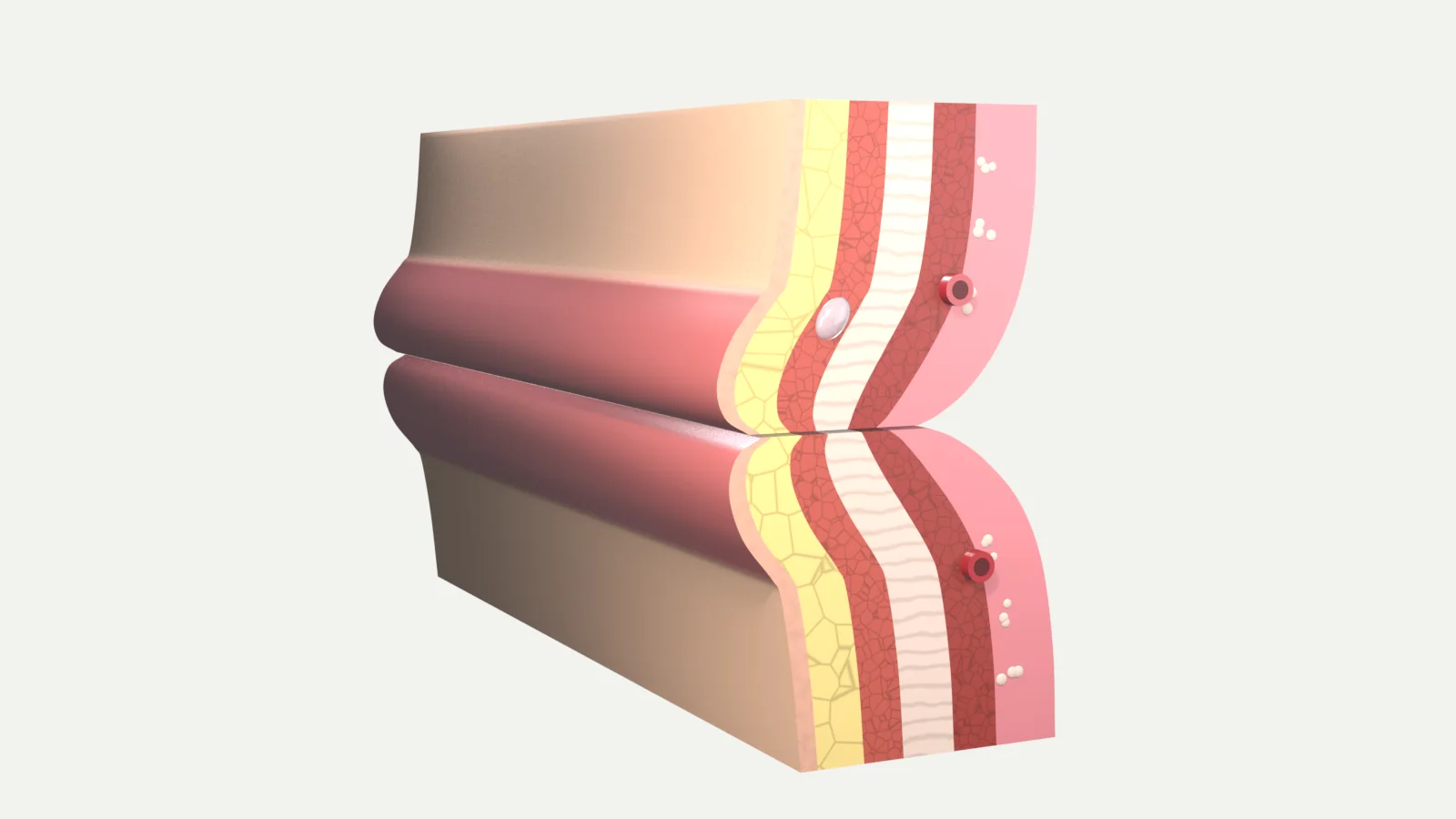
Lip filler is easy to misread on a quote. Two numbers matter before anything else: how many cc you are paying for, and what dissolving would cost if you changed your mind. Then there is a question few people ask: where in the lip the filler actually ends up.
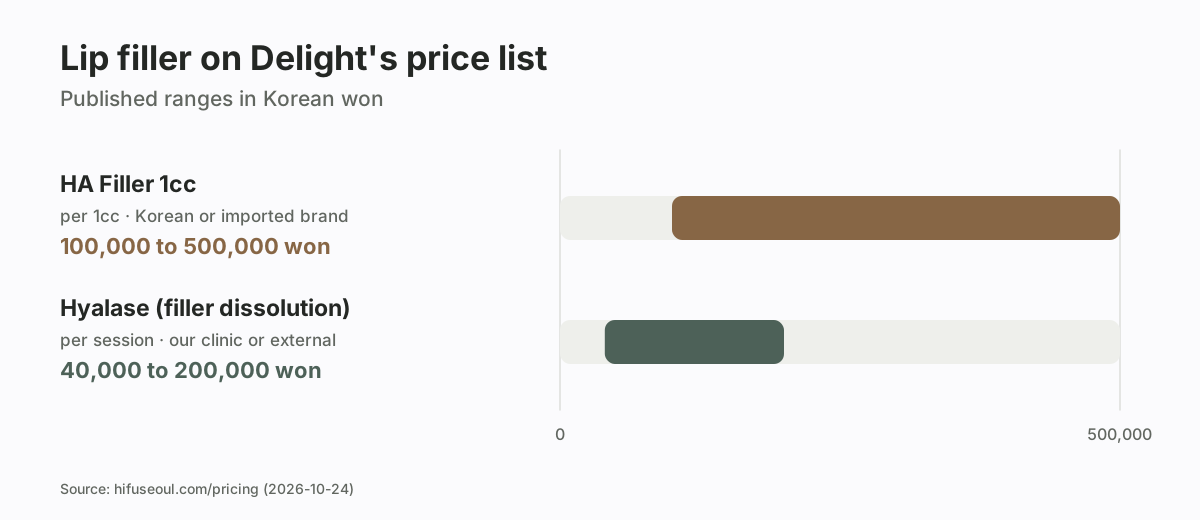
Delight lists hyaluronic acid (HA) filler at KRW 100,000 to 500,000 per 1cc, Korean or imported brand, and filler dissolution with hyaluronidase at KRW 40,000 to 200,000 per session, whether the filler was placed at Delight or elsewhere. The final amount follows the examination. A 2025 review by Korean injectors describes 0.5 to 1 mL per lip as the usual amount, so ask how many cc your quote covers and how they are split between the lips. HA filler can be broken down with hyaluronidase, but fillers differ in how readily they dissolve, and non-HA fillers cannot be dissolved. In a 2026 ultrasound study, filler sat in the lip muscle in most treated people, whatever depth had been intended.
What the price list shows
Two rows on Delight's price list cover lip filler. HA Filler 1cc is priced per 1cc at KRW 100,000 to 500,000, a range that spans Korean and imported brands. Hyalase (filler dissolution) is priced per session at KRW 40,000 to 200,000, for filler placed at the clinic or elsewhere. In-person consultation and MetaView photography are separate paid items.
Hong et al. (2025, Life, PMID: 40003724), a review by injectors in Korea, describe 0.5 to 1 mL per lip as the usual amount, with 1.5 mL per lip as a maximum even for larger corrections, and note that too much product tends to thicken the lip rather than turn it outward. Across 16 studies with 3,692 patients, a 2026 systematic review by Miranda Cerna (Aesthet Surg J Open Forum, PMID: 42039797) found that most protocols used 1 to 2 mL per session.
The same Korean review notes that a natural result may take two sessions, two to four weeks apart. Delight's HA filler page describes a similar habit: a conservative first session and, if needed, more at the four-week review. A quote for 1cc now with a possible top-up later is a different plan from 2cc in one sitting, and the quote should say which one it is.
Where lip filler ends up: the ultrasound study
Harris et al. (2026, Plast Reconstr Surg, PMID: 41494527) scanned the lips of 126 adults at clinics in London and Amsterdam with high-frequency ultrasound; 52 had had HA lip filler and 74 had not. They measured five layers: subcutaneous fat, two parts of the ring muscle around the mouth (the pars marginalis and the pars peripheralis), connective tissue and the inner wet mucosa. Each layer averaged between 1.37 and 2.29 mm, and the whole lip averaged 8.36 mm in the upper lip and 9.01 mm in the lower.
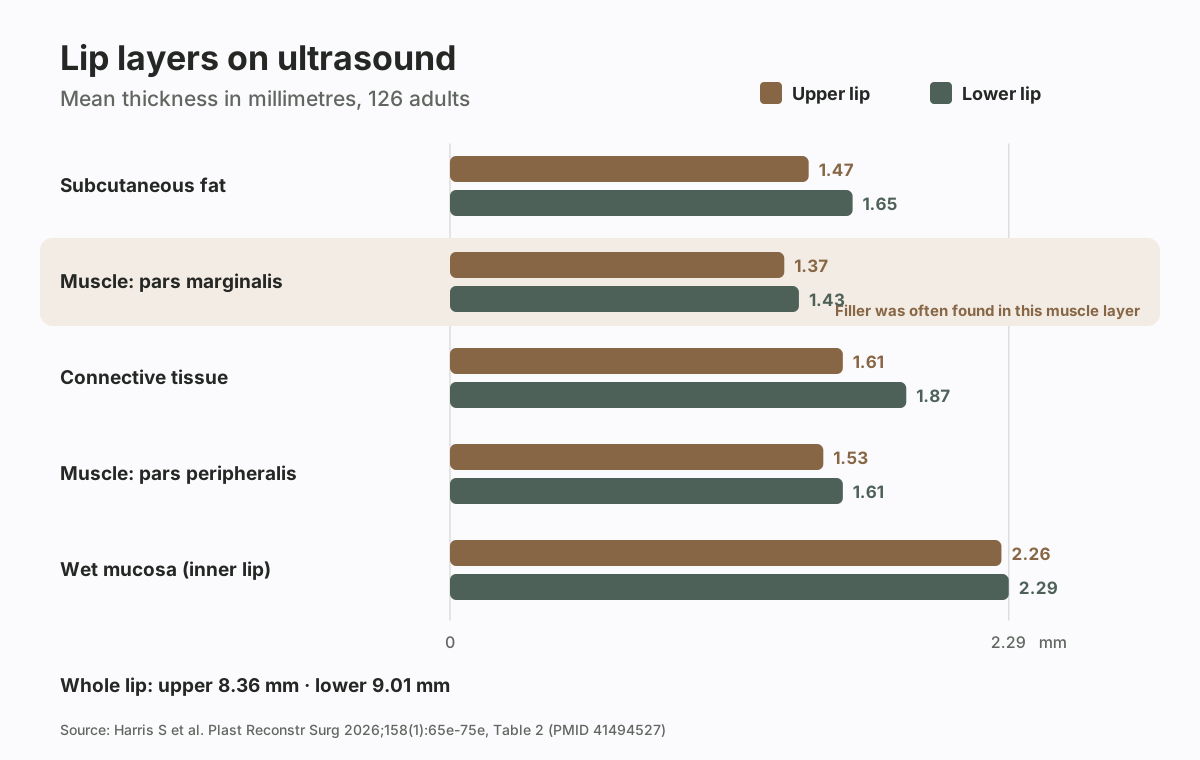
The finding that matters for a patient is where the filler was. In treated lips it was often in the pars marginalis, that is, in the muscle, whatever depth had been intended, and the authors conclude that the fat layer is too thin to hold filler reliably. Filler had spread beyond its injection site in 27 of the 52 treated people. Spread was more common after vertical techniques such as tenting or the so-called Russian lip (22 of 30) than after horizontal ones (5 of 21), and vertical techniques were linked to deeper deposits and increased blood flow on ultrasound. The study is cross-sectional with a modest sample, so it shows associations rather than causes.
Why technique and the arteries matter
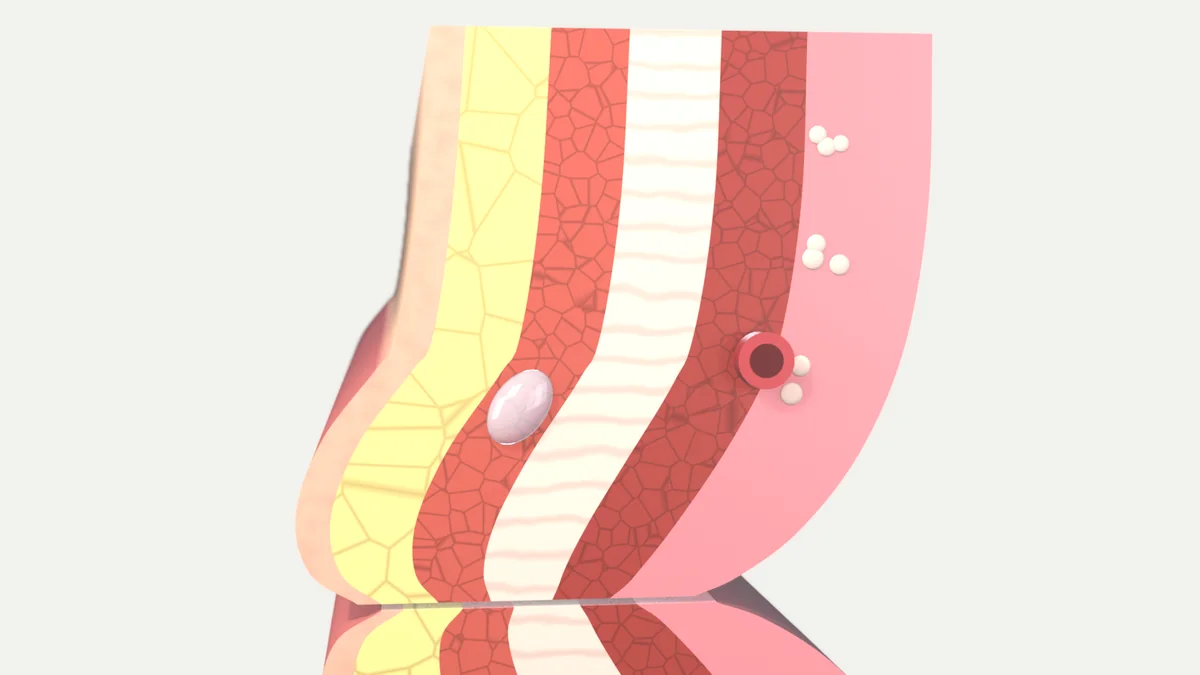
The lip's main arteries run deep. Hong et al. describe the superior labial artery, about 1 mm across, running between the inner mucosa and the ring muscle at the level of the lip border, with the lower lip's artery in a similar plane. They treat deep injections at the lip border as high risk, and note that the arteries branch symmetrically on both sides in only about half of people. Delight's HA filler page states that needle or cannula is chosen by area and product. Across the studies in the 2026 systematic review, no single technique, instrument or HA product came out ahead, and needle-only and needle-plus-cannula approaches had comparable safety.
Blanching or a mottled patch on the lip after an injection needs attention at once: Hong et al. describe blocked blood supply as one of the most serious complications, treated with high-dose hyaluronidase.
Dissolving: what hyaluronidase can and cannot do
HA filler is described as the standard for lips partly because it can be reversed (Hong et al.). Hyaluronidase, an enzyme, breaks HA gel down. Delight's HA filler page sets out the limits: products differ in how readily they dissolve, some may need more than one session, and non-HA fillers cannot be dissolved at all. In a laboratory study of 16 HA fillers, Faivre et al. (2024, Aesthet Surg J, PMID: 38366708) found the way a filler is manufactured to be the most important factor in how readily it can be reversed. If your filler was placed elsewhere, its product name helps the doctor plan. Delight's dissolution row covers filler placed at the clinic or elsewhere, and its filler page notes that poorly placed filler from before may need partial dissolving before any new product goes in, so a first quote can include both rows.
Because hyaluronidase can be animal-derived, allergy is a common worry. A 2021 UK guideline by Murray et al. (J Clin Aesthet Dermatol, PMID: 34840662) notes that an allergy to wasp or bee stings increases the risk of an allergy to hyaluronidase, and discusses skin testing. Mention any sting allergy before a dissolving session.
When the injection waits
The notice on Delight's HA filler page lists the situations to raise before lip filler: pregnancy or breastfeeding; an active skin infection, cold sore or inflamed acne at the injection site; a known allergy to hyaluronic acid, lidocaine or the BDDE crosslinker; dental work or a vaccination at the site within the past two to four weeks; and an active autoimmune flare or blood-thinning treatment, which are reviewed at the consultation.
Swelling and flights
For swelling, bruising and how long to wait before a flight, use the downtime planning guide.
Checklist for a lip filler quote
- Product. The name, and whether it is a Korean or an imported brand. Delight's filler page records the brand and lot number in a written handover.
- Amount. How many cc, and how they are split between the upper and lower lip.
- Plan. One session, or a planned second session and when.
- Dissolving. Whether it is included, and why.
- Technique. Needle or cannula, and for which part of the lip.
- Separate fees. In-person consultation and MetaView photography.
To plan lip filler around a visit to Seoul, send your dates and any earlier filler details through the consultation form.
Questions readers ask
How much is lip filler at Delight?
HA Filler 1cc is listed at KRW 100,000 to 500,000 per 1cc, Korean or imported brand. The final amount follows the examination, and in-person consultation and MetaView photography are charged separately.
How many cc of lip filler do I need?
The amount is set at the examination. A 2025 review by Korean injectors describes 0.5 to 1 mL per lip as usual, with 1.5 mL per lip as a maximum, and a 2026 systematic review found that most studied protocols used 1 to 2 mL per session.
Can lip filler be dissolved?
Hyaluronic acid filler can be broken down with hyaluronidase, but products differ in how readily they dissolve and some may need more than one session. Non-HA fillers cannot be dissolved. Delight lists dissolution at KRW 40,000 to 200,000 per session, for filler placed at the clinic or elsewhere.
Where in the lip does filler end up?
In a 2026 ultrasound study of 126 adults, filler in treated lips was often found in the muscle layer whatever depth had been intended, and it had spread beyond the injection site in 27 of 52 treated people, more often after vertical techniques.
Why might a second session be suggested?
A 2025 review by Korean injectors notes that a natural result may take two sessions, two to four weeks apart, and Delight's HA filler page describes a conservative first session with more at the four-week review if needed.
相關項目